Assessment of biogenic CO₂ resources in Europe
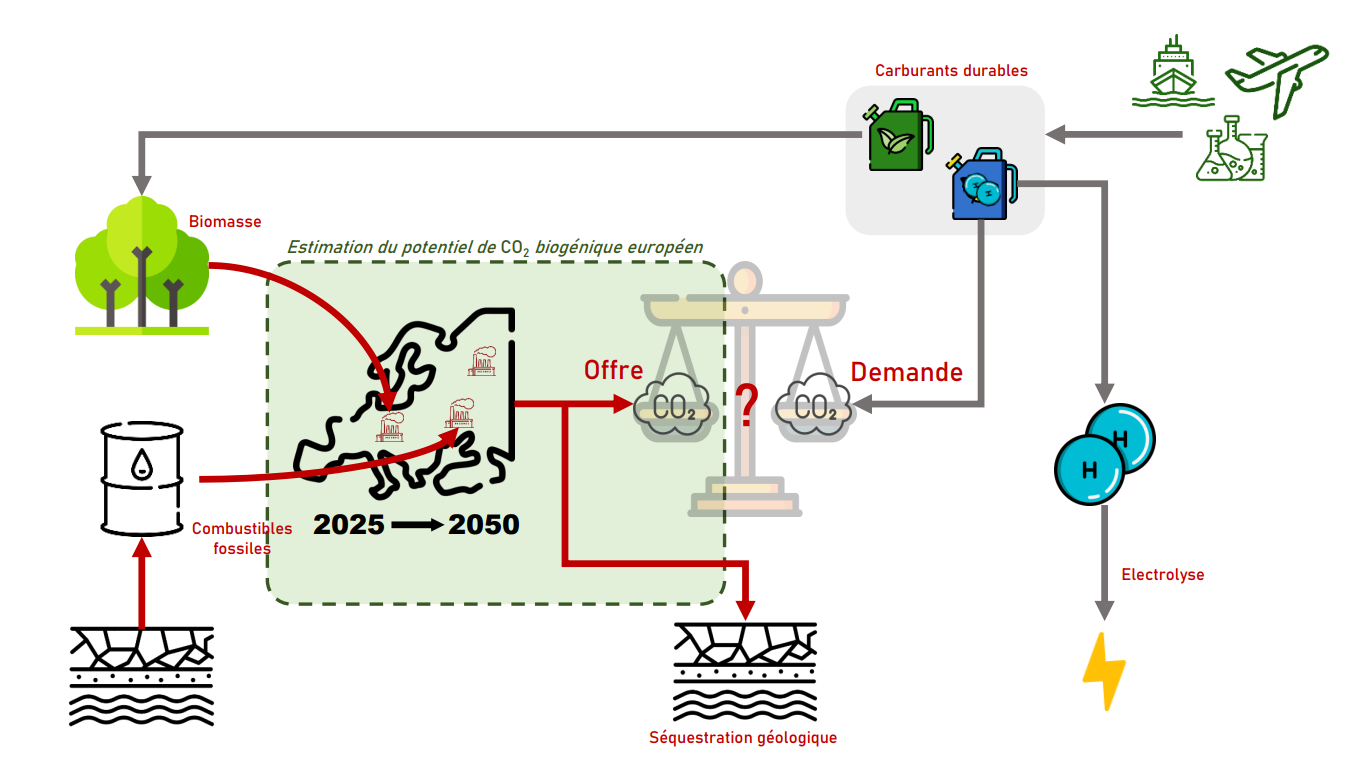
Initially considered a waste product, carbon dioxide is increasingly considered a valuable carbon resource for producing sustainable fuels for defossilising sectors such as aviation, shipping and chemicals (Gray et al., 2021). Ambitious deployment targets have been set in Europe for these fuels, particularly advanced biofuels and RFNBO (Renewable Fuels of Non-Biological Origin), the production of which requires large amounts of captured CO₂ (ReFuel EU Aviation, 2023). From 2041, European regulations will require CO₂ supply to originate exclusively from biogenic sources or to be captured directly from the air (DAC), effectively excluding fossil-based CO₂ (European Commission Delegated Regulation, 2023).
However, biogenic emissions remain poorly characterised, arising from facilities of varying sizes, often geographically dispersed and not clearly distinguished from fossil emissions. They are excluded from regulated emissions under carbon pricing schemes such as the EU ETS (Rodin et al., 2020). Nevertheless, ensuring access to this strategic resource requires a detailed understanding of current sources and their evolution in a rapidly decarbonising Europe.
In this context, this work develops a spatially explicit mapping of available CO₂ resources by combining industrial inventories from public databases with prospective modelling of biogenic emission trajectories in various industrial sectors (steel, cement, pulp and paper, biomass power stations, anaerobic digestion plants, etc.). This work contributes to a broader analysis of the carbon cycle within the energy system. It is connected to the integration of biomass, CO₂ and hydrogen conversion pathways, to meet the demand for sustainable fuels while accounting for resource constraints in line with carbon neutrality objectives.
The aim is to contribute to the institute's system-level perspective by providing robust scientific support for defining robust and internally consistent decarbonisation pathways at the European level. This work builds on complementary expertise within the institute, including techno-economic analysis of CO₂ and synthetic fuel value chains, regulatory monitoring, and the development of prospective scenarios for the evolution of CO₂ supply and the analysis of spatially resolved industrial data.
Gray, N., McDonagh, S., O'Shea, R., Smyth, B., & Murphy, J. D. (2021). Decarbonising ships, planes and trucks : An analysis of suitable low-carbon fuels for the maritime, aviation and haulage sectors. Advances in Applied Energy, 1, 100008. https://doi.org/10.1016/j.adapen.2021.100008
RÈGLEMENT (UE) 2023/2405 DU PARLEMENT EUROPÉEN ET DU CONSEIL du 18 octobre 2023 relatif à l'instauration d'une égalité des conditions de concurrence pour un secteur du transport aérien durable (ReFuelEU Aviation) (2024).
Rodin, V., Lindorfer, J., Böhm, H., & Vieira, L. (2020). Assessing the potential of carbon dioxide valorisation in Europe with focus on biogenic CO2. Journal of CO2 Utilization, 41, 101219. https://doi.org/10.1016/j.jcou.2020.101219