Hole spin qubits in silicon and germanium are among the promising candidates for future large scale quantum processor. They offer high performances while being compatible with microelectronics fabrication technologies. Their strong intrinsic spin-orbit coupling enables fast electric drive, but also makes them more sensitive to charge noise, limiting their coherence times.
We have demonstrated that the alignment of the external magnetic field plays a key role in the performance of hole spin qubits. Our experiment shows that the qubit sensitivity to charge noise coming from its environment depends significantly on the magnetic field orientation. In particular, there exists regions where the qubit is effectively decoupled this noise. Control efficiency also varies with the direction of the field. Notably, the maximum control efficiency occurs precisely where the qubit is least sensitive to noise, and thus most coherent (see
Figure). These ideal operation points are not fixed: they can be tuned by changing the voltages on the gates controlling the qubit confinement. We have demonstrated that such an electrical tuning allows ideal operation points on multiple qubits to aligned to the same magnetic field orientation. Single qubit gate fidelities on multiple qubits being simultaneously maximized. These results are supported by theoretical models demonstrating the general existence of operating points where noise resilience and control efficiency are simultaneously optimized.
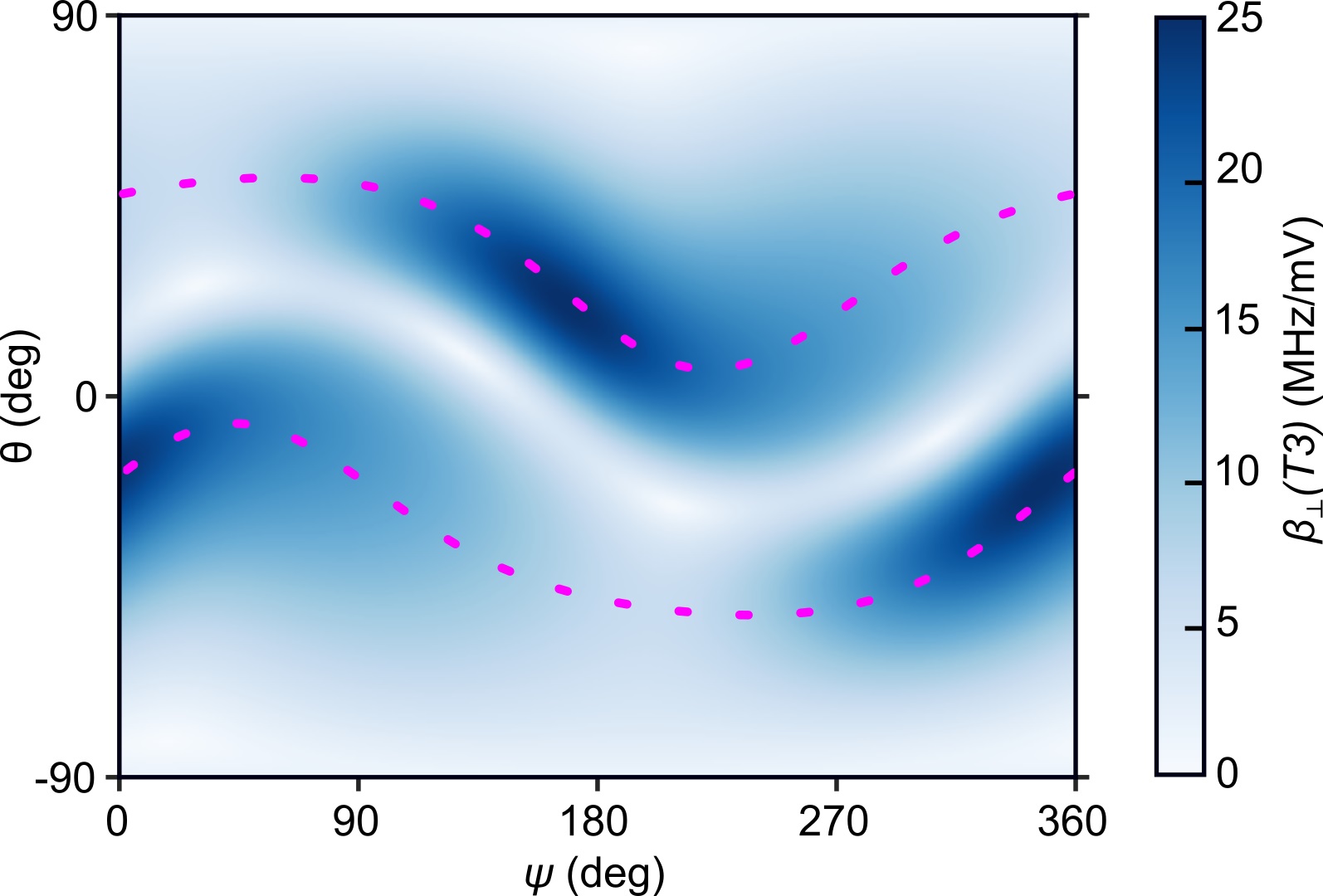
Figure: Regions of optimal operation. The map shows the control efficiency as a function of polar and azimuthal angle of the applied magnetic field. Regions of maximum efficiency (dark blue) lie where the qubit is insensitive to charge noise (dashed lines), which provide experimental evidence of optimal operation conditions.
This proof of concept opens the path for multi-qubit architectures more robust and more scalable. The same conclusions would also apply to other material hosting hole spin qubits, such as Ge/SiGe heterostructures.
Supervisory Authority of the Joint Research Unit (UMR)
PHELIQS: CEA, UGA, and Grenoble INP-UGA
MEM: CEA and UGA
Fundings
- PEPR Presquile
- European projects : QuCube, QLSI et QLSI2
- LaBEx LANEF