In the field of wireless communication technologies, front-end filters are placed between the antenna and the signal processing circuit to determine the operating spectral band. These filters exploit the slow propagation of sound waves in a crystal to achieve this function in a compact design. Achieving unidirectional propagation within these devices would open up new functional possibilities, such as selective signal routing. It is well established that magnetic materials intrinsically break time reversal symmetry. One solution being studied by researchers would be to integrate a thin magnetic film onto a piezoelectric substrate. The ensuing magneto-elastic coupling that is created at the interface between the two materials allows to transfer the non-reciprocity of the magnetization dynamics to the surface acoustic waves.
In this work, a team from CEA-Irig/SPINTEC participated in the development of a surface acoustic wave (SAW) acoustic isolator operating at room temperature, integrating a thin film of ferrimagnetic yttrium iron garnet (Y3Fe5O12, YIG) on a piezoelectric lithium niobate substrate (see Figure). The choice of YIG, a material with very low magnetic and acoustic damping, allows for strong coupling between magnetic and sound waves.
Analysis of the absorption spectra shows several absorption peaks corresponding to stationary perpendicular spin wave modes. These modes exhibit the strong non-reciprocity sought when the direction of propagation of the acoustic wave is reversed.
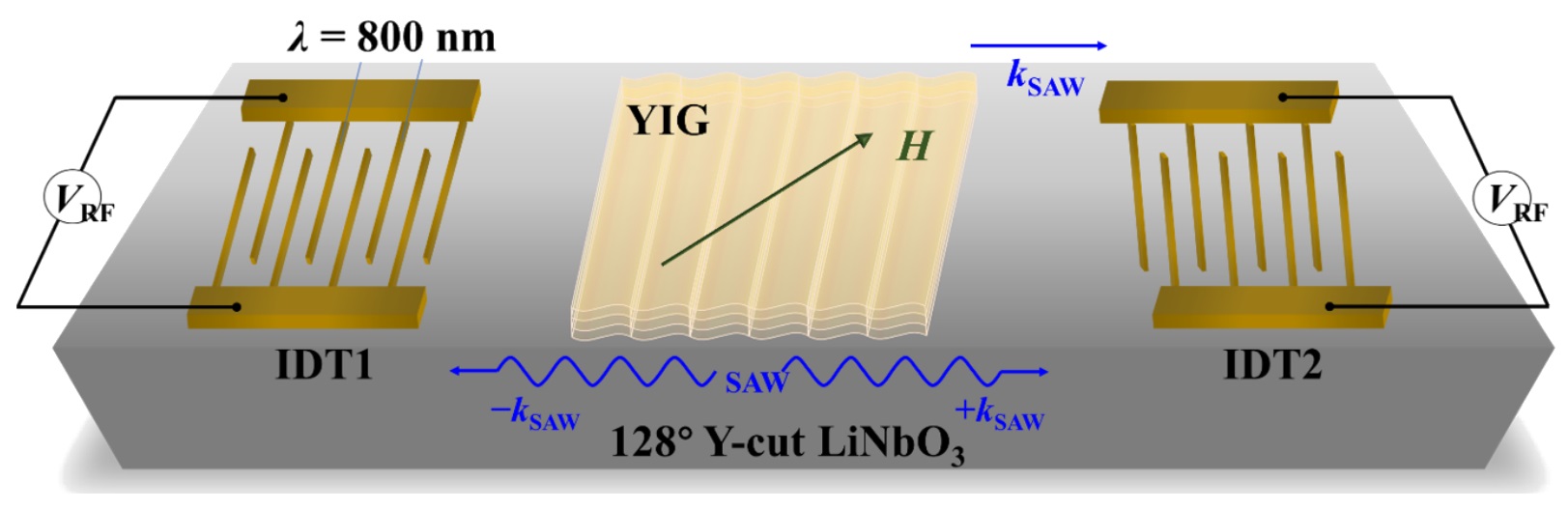
Figure: Surface acoustic wave (SAW) transmitter: Two interdigitated transducers (IDT1 and IDT2) generate elastic surface waves in a piezoelectric crystal, which then interact with a magnetic garnet thin film deposited on the same surface.
Our results demonstrate that integrated YIG–SAW devices are an effective platform for nonreciprocal acoustic transport. They thus pave the way for a new generation of hybrid dielectric materials combining piezoelectricity and ferromagnetism.
Fundings
Q-SPIN chaire d’excellence LANEF by Prof. YoshiChika Otani
Collaboration
RIKEN and ISSP (Institute for Solid State Physics) Tokyo University (JP)