Uranium (a natural
radionuclide*) is an environmental contaminant found in certain soils and waters, particularly near mining or nuclear activities. Its accumulation can pose potential risks to ecosystems, agrosystems and human health, as the radionuclide has toxic chemical effects.
Its toxic effects on plants are well known, but the molecular mechanisms involved remain poorly understood. This study, conducted by researchers at
CEA-Irig/LPCV and other collaborators, represents a major breakthrough with the direct identification of cellular proteins targeted by uranium, revealing a new mechanism of uranium toxicity in plants.
Using an integrated
metalloproteomics approach* combining chromatography, mass spectrometry and NMR, researchers identified 57 proteins capable of binding to uranium from Arabidopsis thaliana cell extracts. One of these, GRP7, plays a key role in RNA regulation. The study shows that uranium binds to two specific sites on this protein and prevents its normal interaction with nucleic acids, thereby disrupting gene expression regulation.
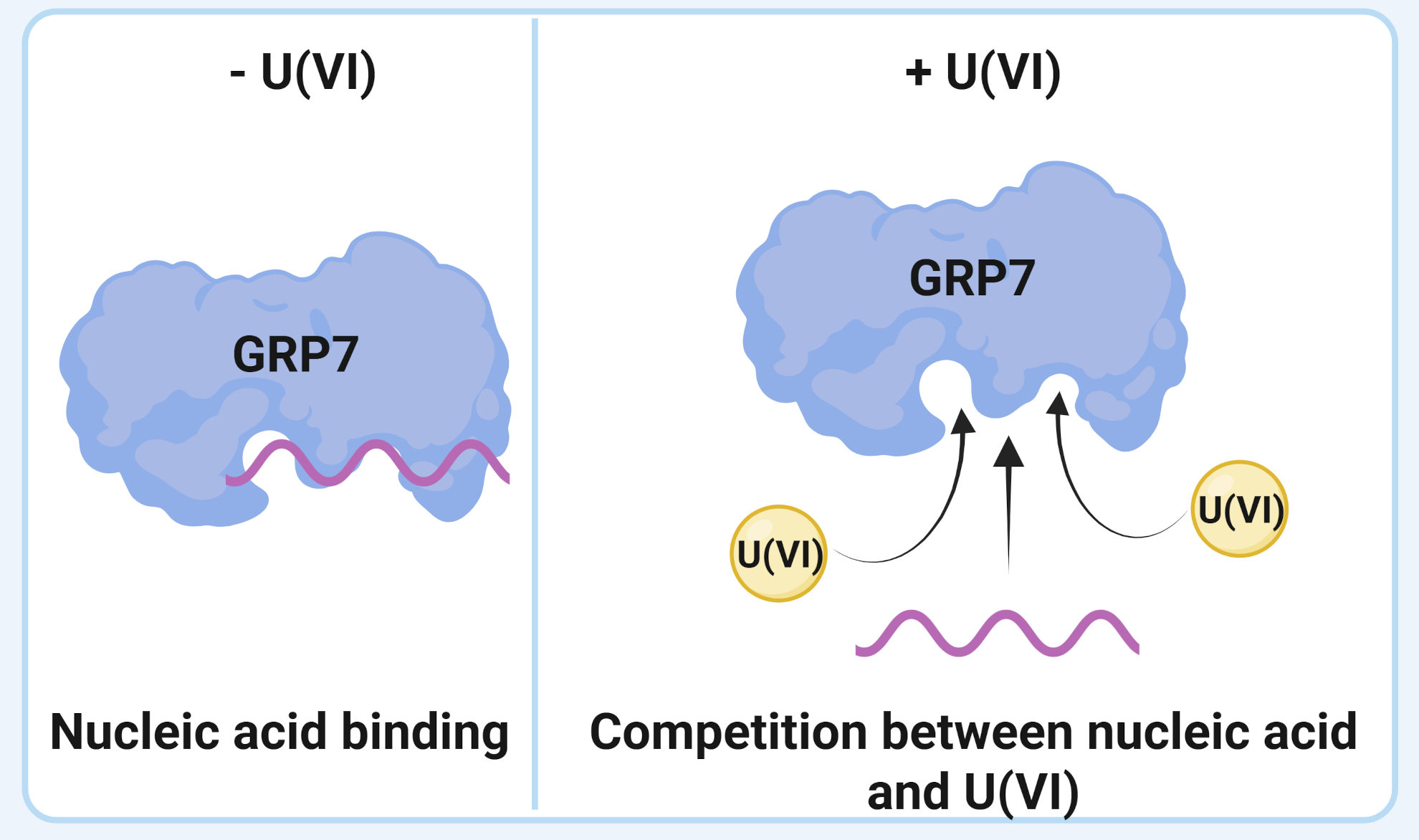
For the GRP7 protein, the study reveals that the ionised form of uranium U(VI) binds to two sites and interferes with RNA binding, thereby disrupting gene regulation mediated by this protein. This reveals a completely new mechanism of uranium toxicity in plants.
© CEA-Irig/LPCV/Metalstress/C. Alban (CC BY license)
This work reveals a novel molecular mechanism of uranium toxicity in plants. It opens up new insights for better assessing environmental risks and developing strategies for soil decontamination using plants (phytoremediation).
Radionuclide*: a type of radioactive atom.
Metalloproteomics approach*: an approach enabling the study of all proteins containing one or more metal ions in an organism or cell extract.
Tutelles UMR : Univ. Grenoble Alpes – INRAE – CEA – CNRS
Fundings : ANR-17-CE34–0007, GreenU project; ANR-17-EURE-0003, CBH-EUR-GS; ANR-10-INBS- 08–3, the French Proteomics Infrastructure, (ProFI).
Collaborations : IBS, CEA-Irig Grenoble ; UA13 BGE, CEA-Irig Grenoble ; LCBM, CEA-Irig Grenoble; Laboratoire de Spectrométrie de Masse BioOrganique, IPHC UMR 7178, Université de Strasbourg.