To enhance the sensitivity of NMR (Nuclear Magnetic Resonance*) spectroscopy, a team at the
MEM Laboratory at CEA-IRIG has developed a
hyperpolarization technique* known as
dynamic nuclear polarization* (DNP) at ultra-low temperatures (20 K). However, the extreme sensitivity achieved with this instrument—virtually unique in the world—has revealed a downside: fluctuations in the detected signals from one scan to the next exceed thermal noise, generating artifacts that render certain multidimensional experiments partially unusable.
Solid-state NMR with hyperpolarization (DNP) offers the advantage of enabling the structural analysis of organic compounds through the detection of
13C/15N nuclei without the need for isotopic enrichment. For example, this technique allows for the observation of
“double-quantum” coherences* between two
13C atoms (whose abundance is only 1%) even in the presence of
“single-quantum” coherences* that are approximately 104 times more intense. However, these experiments are often affected by artifacts generated by fluctuations in the “single-quantum” signals.
In this study, the authors achieved the feat of eliminating the main source of artifacts —
i.e. the intense signals from isolated
13C atoms—while preserving the
13C-13C two-spin correlations that provide information on the spatial proximity between carbon atoms, thereby preventing the appearance of parasitic noise.
« Here we present a method, based on the use of RF pulses, for removing t1 noise from
13C –
13C correlation spectra. This filter, called the zz filter, significantly improves the quality of spectra obtained on commercial DNP spectrometers operating at 100 K, as well as on our home-built prototype that can reach 20 K. This methodology, tested on model samples such as ampicillin (an antibiotic), produces clearer and more sensitive spectra with an improvement in the signal-to-noise ratio by up to a factor of 5, making it possible to detect long-range interactions that were previously invisible » explains Sabine Hediger, one of the co-authors.
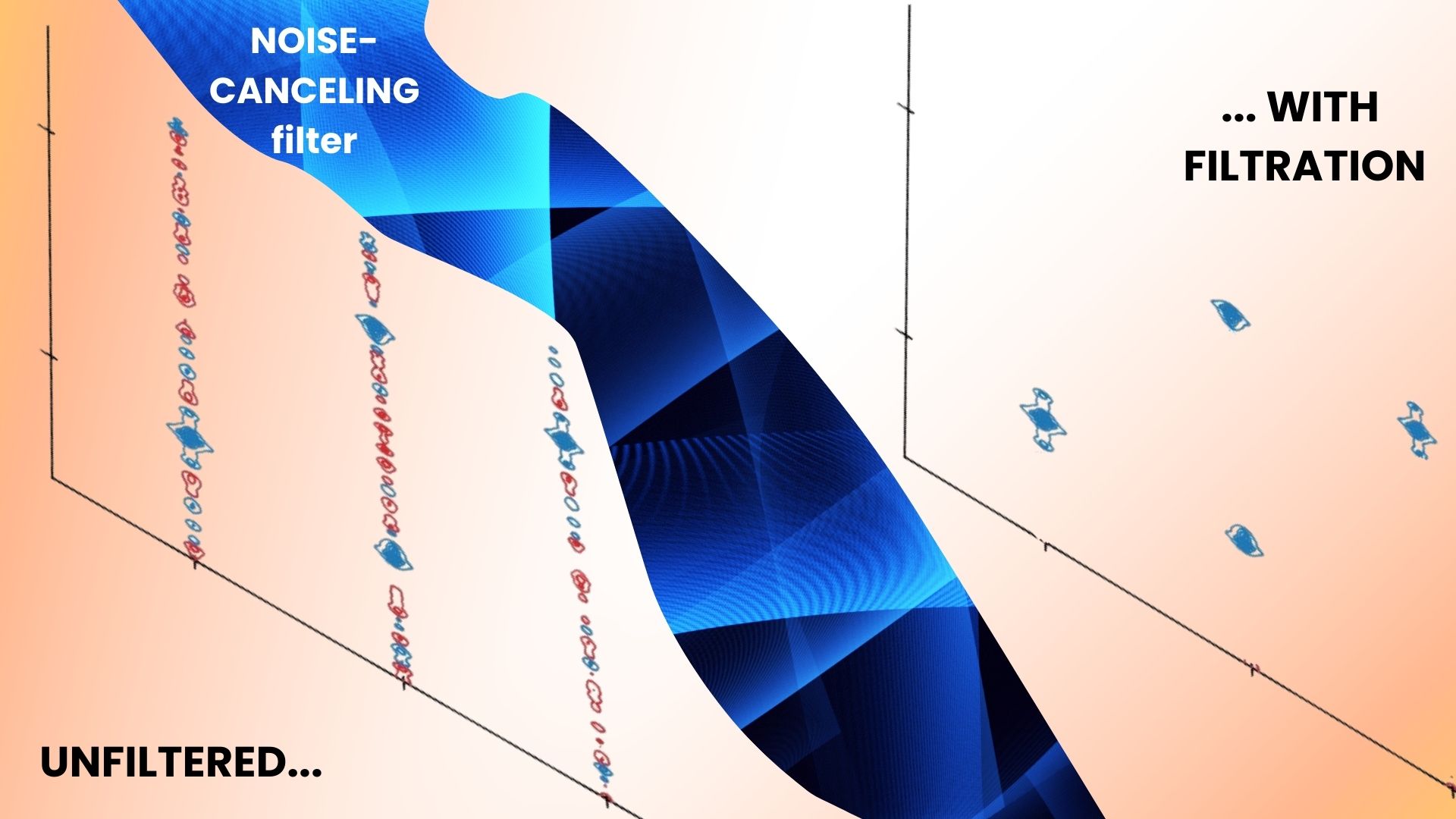
Figure: On the left, the typical DNP-NMR spectrum obtained to date; on the right, the same spectrum using a modified pulse sequence based on the combined use of two RF pulse sequences: 1. A zz filter that specifically removes unwanted correlations (spurious signals) prior to detection 2. A z filter that removes residual noise, ensuring a final spectrum free of artifacts. © CEA
Thanks to this new methodology, the unprecedented sensitivity of this instrument—virtually unique in the world—will enable the study of complex systems, for which it is difficult, if not impossible to extract a structural information at the atomic scale. This could, for example, involve the structural analysis of amorphous active ingredients in drug formulations, or ligand-binding at the surface of in innovative nanomaterials.
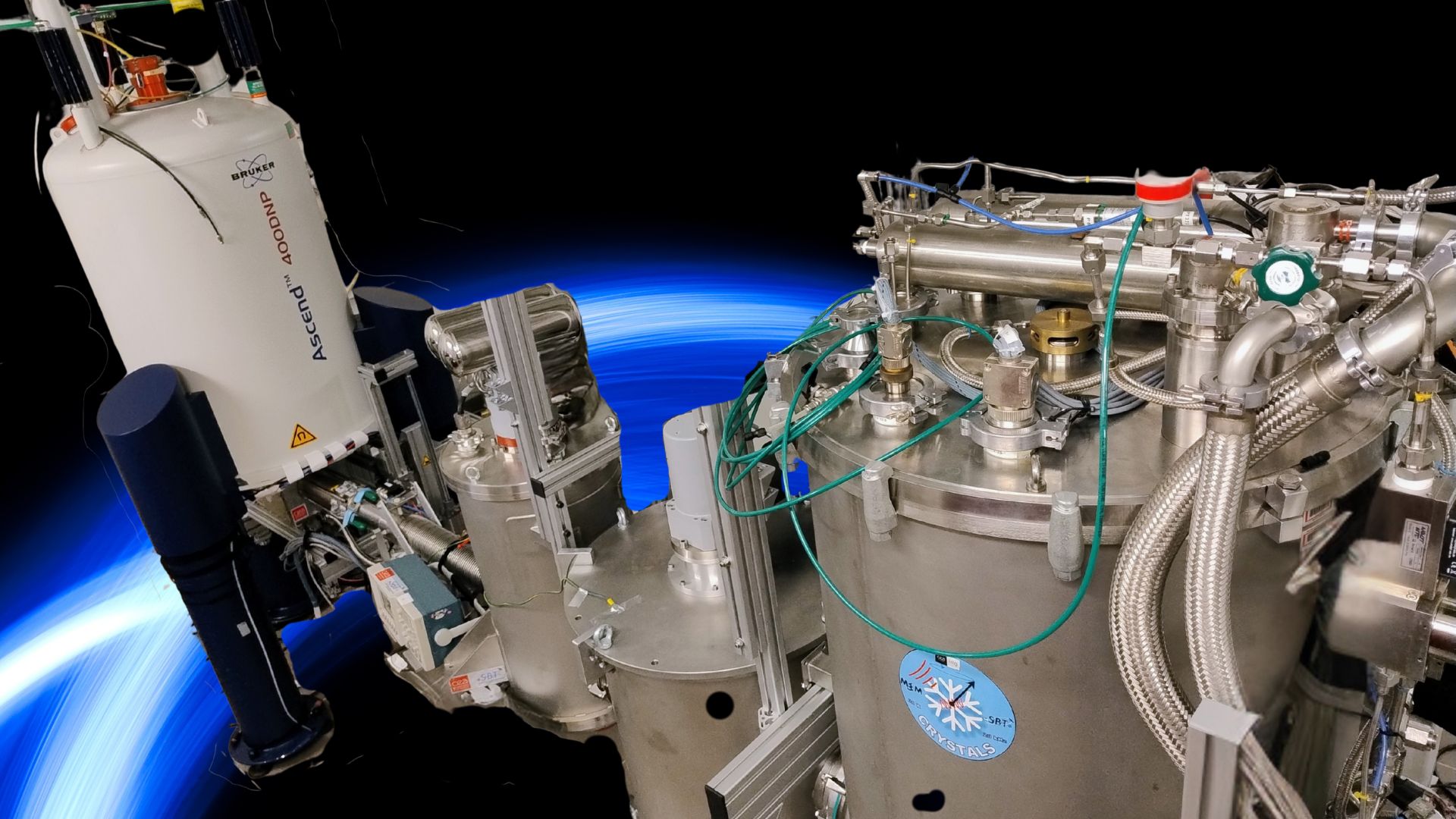 Experimental set-up
*Nuclear Magnetic Resonance (NMR) is an analytical technique used to study the structure and dynamics of molecules. It is based on the detection of signals emitted by atomic nuclei subjected to a strong magnetic field.
*Hyperpolarization is a technique that increases the sensitivity of NMR by further aligning atomic nuclei in a specific direction, thereby amplifying the detected signal.
*Dynamic Nuclear Polarization (DNP) is a hyperpolarization method that uses unpaired electrons (free radicals) to transfer their polarization to atomic nuclei, thereby increasing the sensitivity of NMR. What sets this method apart is that it is performed at ultra-low temperatures (20 K).
*”Double-quantum” coherence: signals detected between two atomic nuclei (for example, two carbon-13 atoms) provide information about the interactions between these nuclei.
*”Single-quanta” coherence: Signals detected on a single atomic nucleus, which are generally more intense but provide less information about interactions between nuclei.
MEM is a joint research unit (UMR): Univ. Grenoble Alpes, CEA, CNRS
Fundings: ENS-Lyon, ANR (ANR-17-EURE-0003 through the labEx Arcane, ANR-15-IDEX-02 through the CDP Glyco@Alps2, and ANR-22-CE07-0046-03), FEDER