Redox metalloenzymes* represent a promising path toward more sustainable chemistry thanks to their high selectivity and efficiency under mild conditions (close to ambient temperature and pressure). However, their application remains limited by their stability, particularly with respect to oxygen. Among these, CO dehydrogenase (CODH) stands out as the most effective catalyst to date for CO₂ activation. In this context, researchers at
CEA-Irig/LCBM are developing innovative approaches to push the limits of CODH for the electroreduction of CO₂ to CO, a fundamental molecule in chemistry.
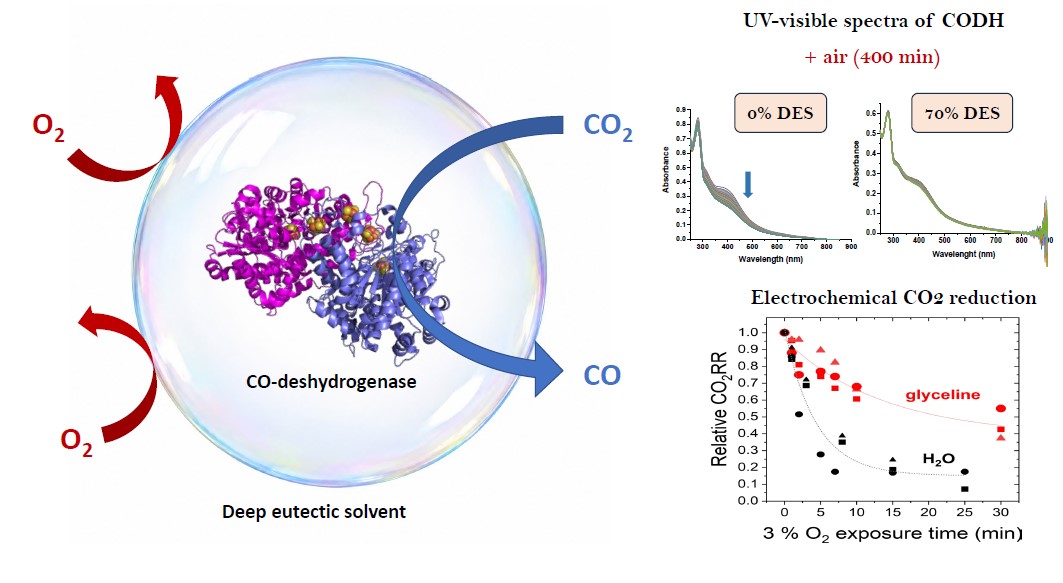
The results show that deep eutectic solvents (DES) significantly improve the oxygen (O₂) resistance of CODHs while enabling the electrocatalytic reduction of CO₂ to CO. Indeed, in an aqueous medium, the enzymes rapidly lose their activity in the presence of O₂ (half-life* of 30 min), whereas in hydrated glyceline, the half-life reaches 432 min, with activity still detectable after 24 h. The electrodes also remain active in the presence of 14% O₂, with only an 11% loss of activity. The bioelectrochemical conversion of CO₂ to CO can thus be carried out in the presence of air simply by controlling the solvent environment and the electrode potential.
© CEA-Irig/LCBM
Figure : CODH, an oxygen-sensitive enzyme, is protected by deep eutectic solvent (DES). The UV-visible spectrum of the enzyme exposed to air for 400 minutes demonstrates the enzyme’s stability in the presence of 70% DES. In electrochemistry, the enzyme can be used for the electrocatalytic reduction of CO₂ to CO in the presence of 3% O₂, by adding glyceline (the DES used in this experiment) to the reaction medium.
This research holds great promise for the future integration of fragile catalysts, such as CODH, into operational devices. Future work will focus on developing new DES-based reaction media capable of improving O₂ tolerance without affecting enzymatic activity.
Bioelectrodes*: electrodes that incorporate an active biological component, such as enzymes, to carry out or catalyze an electrochemical reaction.
Deep eutectic solvents*: new category of environmentally friendly solvents with adjustable properties; these mixtures of low-volatility compounds form a liquid at low temperatures.
Redox metalloenzymes*: enzymes that contain one or more metal ions involved in redox reactions.
Half-life*: the time after which the activity of metalloenzymes has decreased by half.
UMR : LCBM (CEA, CNRS, UGA).
Fundings : ANR-22- PESP-0010: Projet ciblé "POWERCO2" within the PEPR project SPLEEN.
Collaborations : University of Hohnenheim (Germany), DCM (UGA, CNRS).