A battery cell heats up when operating. Its volume also changes over successive charges and discharges, and as it ages. To preserve the performance of certain cells, known as prismatic cells because of their rectangular shape, it is therefore necessary both to remove heat and to maintain mechanical compression. These functions are usually performed by separate components: a cooling plate and compression plates held in place by rods or straps.
As part of the Horizon Europe NextBat project, CEA-Liten's teams decided to combine them. Their patented solution involves immersing the cells in a pressurised dielectric (i.e. electrically insulating) oil. “The idea was to combine mechanical compression and thermal management by using the dielectric fluid," explains Lionel De Paoli.
The module they designed contains fourteen cells, with an energy capacity of 3.9 kWh. The fluid circulates between the cells and comes into contact with all of their faces. Unlike a cold plate placed underneath the cells, immersion provides more uniform cooling. It also cools the surrounding electrical connections and electronic boards. Kept at around one bar above atmospheric pressure, the oil also applies uniform, controlled compression. With a conventional mechanical assembly, the applied force increases as the cells swell. The hydraulic system provides better control of this pressure despite changes in cell volume. However, the benefit of this compression in terms of ageing has yet to be fully quantified.
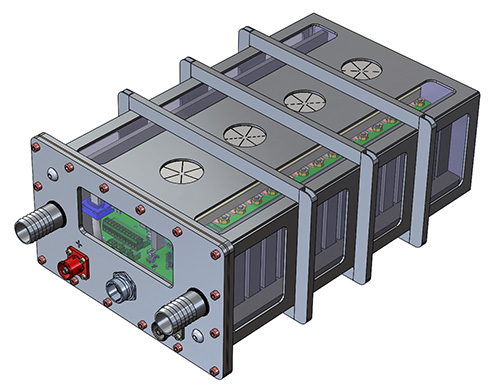
This approach requires a sealed casing that can withstand not only the operating pressure, but also the pressure generated by any thermal runaway. During this uncontrolled reaction, a cell can suddenly release heat and gas. The researchers studied this phenomenon on a cell immersed in a reinforced test chamber. These experiments fed into the numerical models used to size the casing and its four safety vents. These vents must open at a set pressure to release the gases and preserve the integrity of the module. The spacing between the cells, as well as the fluid, is also intended to help limit thermal runaway propagation, although this has yet to be verified experimentally.
Although the added oil makes the module heavier, for certain demanding applications, better cooling could reduce the number of modules required at battery level. “We can put fewer modules in the vehicle because they will age more slowly," adds Sébastien Fiette. Simulations indicate a weight saving of up to 18% in some scenarios, notably for a hybrid boat making round trips throughout the day.
The mechanical enclosure is currently being manufactured. Tests on complete modules will make it possible to compare these projections with actual performance and to assess the safety of this architecture.