Superbugs are antibiotic-resistant microorganisms responsible for approximately 700,000 deaths per year, a number that could potentially reach 10 million per year by 2050.
P. aeruginosa, a major pathogen in hospital-acquired infections, is often multidrug-resistant, and is particularly dangerous for patients on mechanical ventilation. It also frequently causes persistent lung infections in patients with cystic fibrosis.
Due to its key role in pathogenesis, the
Type 3 Secretion System* (T3SS), a virulence factor of
P. aeruginosa, represents a major therapeutic target. Inhibition of this factor has been shown to reduce the virulence of
P. aeruginosa in
in vitro and
in vivo models.
The goal of the project was to isolate human monoclonal antibodies (mAbs) capable of reducing the pathogenicity of
P. aeruginosa by targeting the T3SS. To achieve this, the researchers screened specific
B cells* from patients with cystic fibrosis, and successfully isolated mAbs that target T3SS proteins from
P. aeruginosa. They identified two antibodies that bind the PcrV protein located at the tip of the
injectisome* and block toxin injection by the T3SS, thereby reducing the virulence of
P. aeruginosa.
By combining approaches from cellular microbiology, genetics, immunology, and structural biology, the consortium also demonstrated that various anti-PcrV antibodies that inhibit T3SS activity—identified in this study as well as in previous work—act through distinct mechanisms, depending on the
epitope* they recognize.
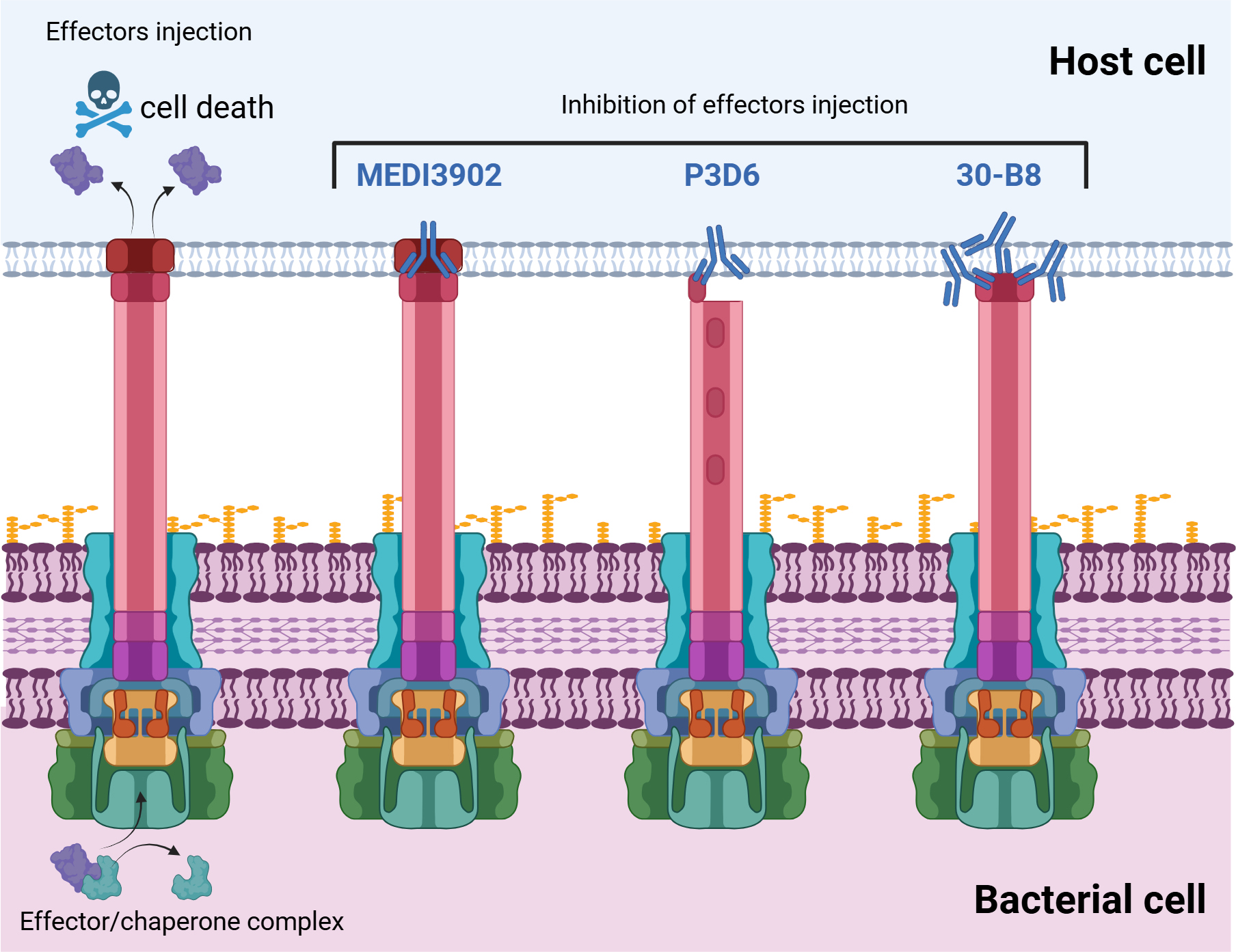
Figure : Following the oligomerization of PcrV into a pentamer at the tip of the injectisome, a pore forms in the host cell membrane, allowing toxins to be injected and ultimately leading to cell death. A single molecule of mAb MEDI3902 binds to the PcrV pentamer and, although it does not effectively block pore formation, strongly inhibits toxin injection. In contrast, mAb P3D6 can bind only to PcrV monomers, and its mechanism of action appears to involve the inhibition of PcrV pentamer assembly. Finally, up to five mAbs 30-B8 molecules can bind simultaneously to the assembled PcrV pentamer, thereby very effectively blocking both pore formation and toxin injection. This latter mechanism of action appears to be the most effective.
This research led to the identification of human mAbs capable of blocking T3SS activity, as well as to the characterization of distinct modes of action for different T3SS-inhibiting antibodies. Comparative analysis of these mechanisms contributes to a better understanding of the differences in efficacy observed among antibodies depending on the recognized epitopes, highlighting that certain mechanisms of action are more effective than others and thereby helping identify which epitopes should be prioritized for the isolation of new effective anti-T3SS mAbs. Furthermore, these results provide important insights for the structural design of potential anti-Pseudomonas vaccines based on the PcrV protein. Taken together, this work opens new avenues for the development of effective alternative therapies in the context of increasingly widespread antibiotic resistance.
Toxins*: substances of bacterial origin that promote infection by directly damaging the host's cells and tissues.
Type 3 Secretion System*: a nanomachine that injects toxins into host cells using a molecular syringe, called an injectisome*, or T3SS needle.
B cells*: immune system cells that produce antibodies.
Epitope*: site on a protein where an antibody binds.
Tutelles UMR : IBS (CEA, CNRS, UGA).
Fundings : ANR, Région Rhône-Alpes.
Collaborations : CHU Grenoble.