Rahman syndrome is a rare genetic disorder marked by neurodevelopmental defects and distinctive facial features, often accompanied by skeletal or cardiac abnormalities. It is caused by mutations in histone H1.4, a protein that helps package DNA inside the cell nucleus. How these mutations alter DNA organization and lead to disease remains poorly understood.
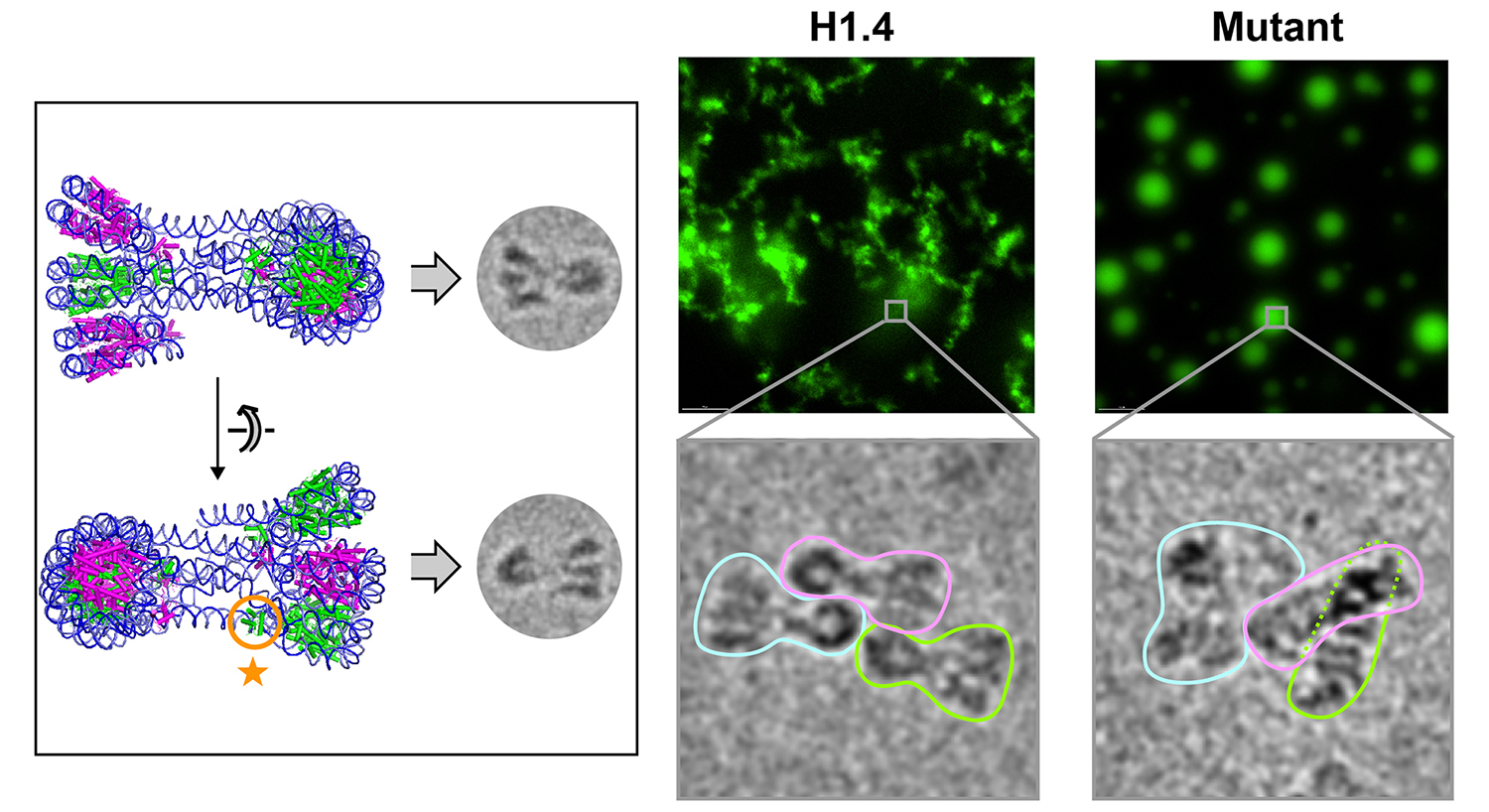
DNA is wrapped around core histones* to form nucleosomes, the basic units of chromatin. Histone H1.4 is a linker histone that binds where DNA enters and exits the nucleosome and brings these DNA segments together, helping to compact chromatin. Rahman syndrome mutations alter a DNA-interacting region of H1.4, weakening its ability to hold these DNA segments together. As a result, chromatin becomes more open and flexible, making the DNA more accessible. This effect can be seen in how chromatin condenses: under the microscope, the mutant protein changes the formation and appearance of condensates produced by phase separation. Because chromatin compaction helps control which genes can be read by the cell, these changes could disturb gene regulation during development and help explain the disease.
© CEA-Irig/IBS/ C. Petosa
Figure : The H1.4 mutation disrupts chromatin compaction and phase separation. The inset on the left shows a compact chain of six nucleosomes bound to H1.4, viewed from two orientations, as well as the corresponding simulated cryo-EM images. The orange star marks the position of one of the H1.4 molecules. On the right, the upper panels show fluorescence microscopy images of the condensates formed by phase separation, while the lower cryo-EM panels show how nucleosome chains are organized. With normal H1.4, the chains adopt compact, relatively regular structures and form fibrous condensates. With the mutant protein, they remain more open and irregular, giving rise instead to rounded, droplet-like condensates.
These findings reveal how histone H1.4 helps organize chromatin and provide new molecular insight into Rahman syndrome. More broadly, they open new avenues for studying how defects in chromatin organization alter gene regulation and contribute to disease.
-
UMR :
IBS, CEA/CNRS/Université Grenoble Alpes.
-
Fundings : ANR RAHMAN, GRAL/CBH-EUR-GS (ANR-17-EURE-0003).
-
Collaborations :
- Institut pour l'Avancée des Biosciences, Univ. Grenoble Alpes, Inserm, CNRS, Grenoble, France
- Institut de Génétique et Biologie Moléculaire et Cellulaire, Université de Strasbourg, CNRS, INSERM, Strasbourg, France.
- Izmir Biomedicine and Genome Center, Dokuz Eylül University Health Campus, Izmir, Türkiye
- Izmir Katip Çelebi University, Faculty of Medicine, Izmir, Türkiye
- University of Rochester Medical Center, Rochester, USA
- Roumen Tsanev Institute of Molecular Biology, Bulgarian Academy of Sciences, Sofia, Bulgaria