Gene expression is regulated by
post-translational modifications (PTMs)* of histones, such as
acetylation*. These modifications establish a link between cellular metabolism and epigenetic regulatory mechanisms. Identified in 2019, histone lactylation is believed to be a post-translational modification associated with
L-lactate*, which is particularly abundant in cells where glycolysis is highly active, notably in cancer cells. To date, the role of lactate in histone lactylation in healthy tissues remains poorly characterized.
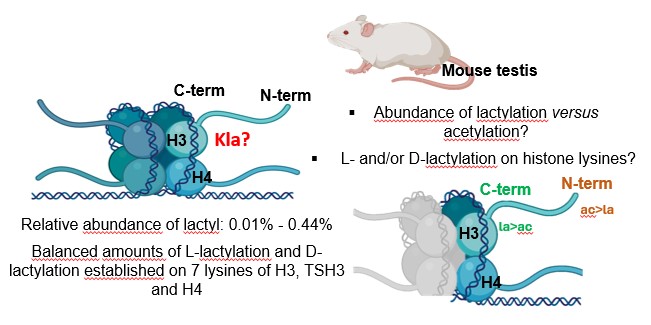
In this study, the researchers analyzed the lactylation profiles of histones extracted from the testes of healthy mice. Using a quantitative proteomics approach that involved synthetic peptides labeled with heavy isotopes and bearing either L- or D-lactylation, they demonstrated that both
enantiomers coexist on several lysine residues of the extracted histones. These results suggest that lactylation is not exclusively linked to L-lactate derived from glycolysis. They have led the researchers to reexamine the mechanisms by which lysine residues in histones become lactylated. Furthermore, now that the
2026 Nobel Prize in Chemistry has been awarded for research on enantiomeric molecules, the characterization of enantiomers—which can have entirely different physiological effects—is a major challenge in the fields of biology, medicine, and analytical sciences.
© CEA-Irig/BGE/EDyP/D. Pflieger
Figure : Lactylation of mouse testicular histones occurs at low levels throughout the entire H3 and H4 histone sequences, whereas acetylation occurs primarily on the N-terminal tails. Furthermore, in contrast to the current state of the art, we have revealed the presence of both L- and D-lactylation enantiomers on 7 lysine residues of H3 and H4.
While most published studies focus on cancer cells—which are characterized by highly active glycolysis and high levels of L-lactate—this study demonstrates, for the first time using quantitative proteomics, the simultaneous and balanced presence of L- and D-lactylation on histones in healthy tissue. These results reveal an unexpected complexity in the mechanisms of lactylation and challenge the notion that this phenomenon is exclusively associated with L-lactate.
UMR : BGE (CEA, UGA, UA13 INSERM).
Fundings : CHROMACYL (ANR-21-CE44-0035-01), ProFI (ANR-10-INBS-08), GRAL (ANR-17-EURE-0003).
Collaborations : Julie Cocquet, « Epigenetics & Spermatogenesis » Group, Institut Cochin, Paris.