What is your role within CEA-Liten's Solar Technologies Department and the photovoltaic ecosystem?
My field of expertise and focus is the O&M, diagnostics and reliability of photovoltaic systems. My main goal, alongside our teams, is to support power plant operators in improving their operations and making photovoltaics ever more reliable and cost-effective. It also involves, for environmental reasons, managing or extending the end of a system's life and enabling components to have a second life, following a circular economy approach.
These comprise the focus of my research. However, my overall role does not concentrate purely on research, but rather on setting up and management of collaborative research and innovation projects. To this end, at an early stage, I participate in European-level bodies and working groups such as the ETIP-PV, SolarPower Europe's task forces and the PVPS programme of the International Energy Agency (IEA). In these work groups, together with the community of scientific and industrial experts, we co-define PV research and technology roadmaps, to guide European and national schemes for supporting research and innovation.
Who are you? What led you to this role?
I was born and grew up in Greece. I completed my studies and my PhD in Industrial Engineering and Management, at the Polytechnic School of Democritus University.
I then went on to seek international experience, starting with a postdoctoral position at the Odeillo solar furnace, in the CNRS's PROMES laboratory. During that year in France, the CEA took note of my thesis work, which focused on the diagnostics of photovoltaic panels. They contacted me and I was able to move straight on and stay in France for a second post-doc at the CEA's INES laboratories. I went on to have two more wonderful experiences, in Norway and Belgium, still in research and photovoltaics, before returning permanently to the CEA in Savoie.
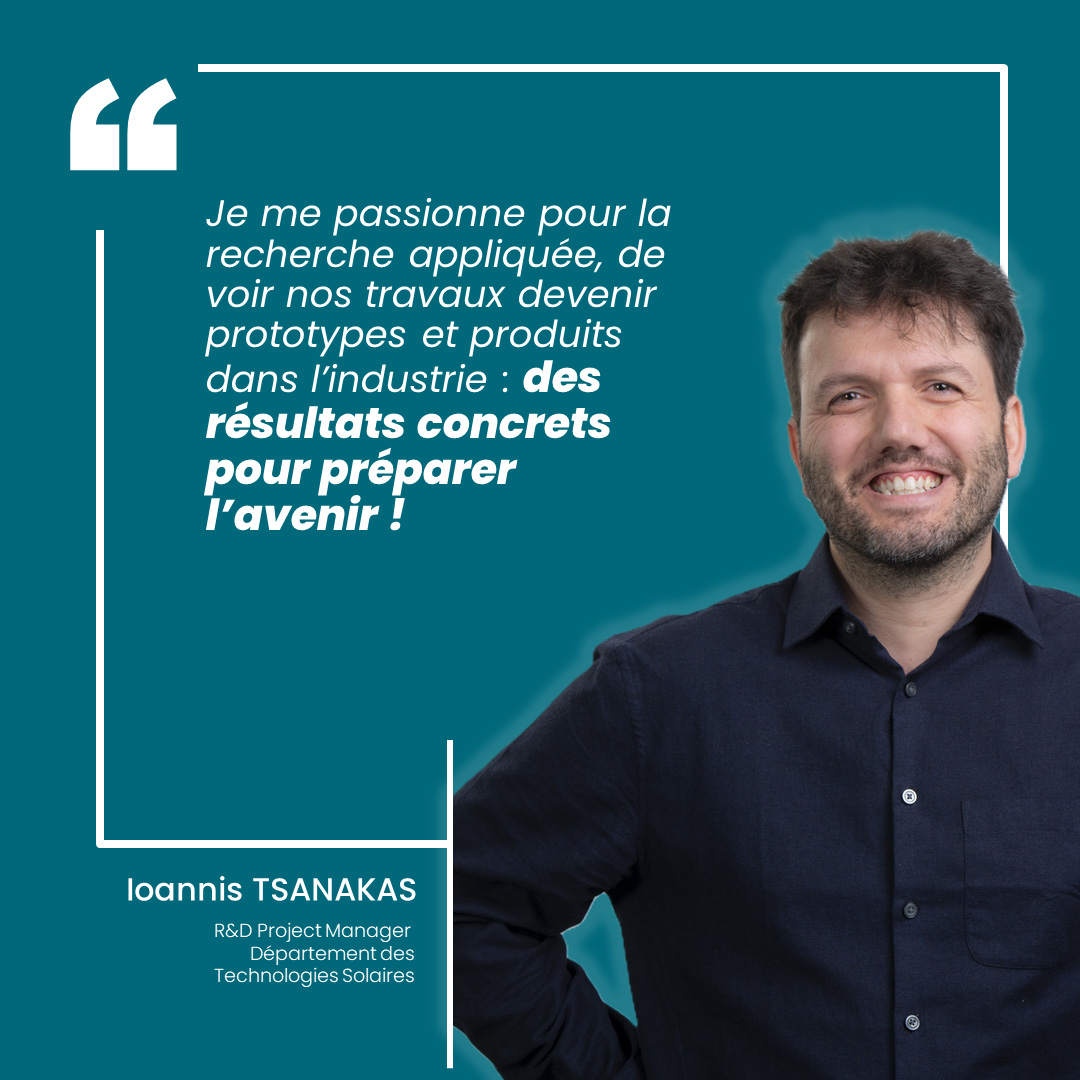
And I must say that I've become passionate about applied research, seeing our work subsequently translated into prototypes and products for the industry: concrete results to prepare for the future! In fact, along the way, I changed my initial plans. As a student, I'd thought I was destined for an academic career and teaching, but I chose research here. (I could also have been a DJ, but that's another story!)
My multicultural background has really shaped my career and what I enjoy doing professionally. I'm a networker at heart; I love the interpersonal aspect of my work and collaborating with other experts and people from different cultures on a shared topic, joining forces to achieve a common goal.
What is our strength in your field today?
For me, the CEA's and the INES site's greatest asset is that we benefit from our excellent infrastructure and equipment across the entire photovoltaic value chain. This is truly a key feature of our positioning that only one or two organisations in Europe can claim at such scale. It enables top-level research.
Another of our strengths, which I personally appreciate, is the highly multidisciplinary nature of our laboratories and researchers. This gives us great agility, and it is very interesting, once again, to bring together different scientific cultures and profiles towards a shared goal.
Finally, I see every day the CEA's reputation and credibility in my field and involvement at European level. This is a key advantage, both for participating in the most relevant projects and as a guarantee of success. We have a real impact and influence.