The mass deployment of photovoltaics worldwide requires addressing challenges related to long-term reliability, environmental sustainability, economic viability, and climate adaptation. The degradation mechanisms of photovoltaic panels are increasingly complex, highly dependent on local environmental conditions (temperature, humidity, UV radiation, dust, extreme weather events), and often governed by localized or early-stage phenomena that are difficult to detect using conventional methods.
Research infrastructure plays a key role in developing advanced diagnostic tools, generating benchmark data that is comparable across sites and climates, and supporting the methodological innovation needed to anticipate failures and extend the lifespan of solar systems. Improving cooperation, harmonizing practices, and increasingly integrating climate, environmental, and socio-economic dimensions are key challenges in Europe and globally.
The CACTUS project, funded by the European Union under Horizon Europe and coordinated by the CEA at INES, was designed to address these challenges by expanding cooperation between research infrastructures dedicated to solar photovoltaics in Europe and Latin America. It also seeks to harness the potential of large-scale European research infrastructures such as synchrotrons and neutron facilities, and to develop common frameworks for assessing sustainability and bankability. It has just concluded after two intense and rewarding years in many respects.
Making significant progress towards advanced diagnostic methods for studying early degradation mechanisms using techniques available at large-scale research facilities
A major scientific achievement of the project was made possible by access to large-scale research facilities, such as the European Synchrotron Radiation Facility and the Institut Laue-Langevin, for the non-destructive study of encapsulated photovoltaic devices, in collaboration with the CEA.
Pioneering work has demonstrated the value of multimodal techniques combining “X-ray Beam Induced Current" mapping, Bragg diffraction imaging, X-ray microtomography, and neutron reflectometry to reveal degradation phenomena invisible to conventional electrical diagnostics. This work paves the way for future advanced studies in photovoltaic reliability analysis, with a direct impact on our understanding of aging mechanisms and the bankability of these technologies.
Structuring and harmonizing datasets, sharing diagnostic tools, and adding value to power plant reliability and operations
CACTUS provided the framework for organizing and harmonizing multisite outdoor monitoring datasets covering desert, tropical, alpine, coastal, and temperate climates. These data have been made available as reference datasets for fault detection and diagnosis, enabling the evaluation and comparison of algorithms for performance monitoring, degradation monitoring, and predictive maintenance.
The data and digital tools developed are available on a public platform
https://zenodo.org/communities/101132182/records?q=&f=resource_type%3Adataset . (Fig. X1).
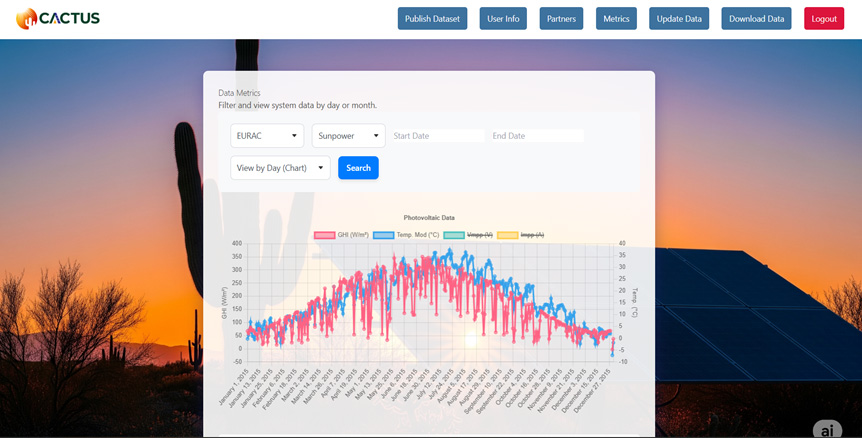
Fig. X1 : Examples of dashboards for photovoltaic monitoring data available through the publicly accessible data platform developed as part of the CACTUS project.
Particular attention was paid to the issue of soiling, a major factor in solar performance loss in many regions, particularly arid and semi-arid ones (Fig. X2).
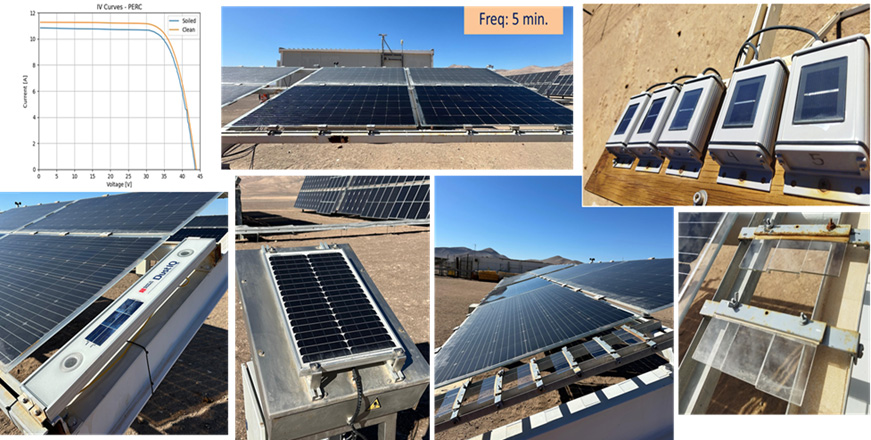
Fig. X2 : Overview of the long-term intercomparison campaign for soiling test equipment in the Atacama Desert, as part of the CACTUS project. Credit: ATAMOSTEC
The project partners have developed and consolidated shared methodological frameworks to ensure a consistent assessment that combines sustainability, economic performance, and the bankability of photovoltaic systems.
By explicitly taking into account climate effects, degradation mechanisms, and actual operating practices, they have, for example:
- Critical analysis, clarification, and harmonization of life cycle assessment approaches applied to the photovoltaic sector,
- Development of decision-support tools combining performance data, degradation assumptions, operating scenarios, and economic parameters.
The consortium's work has identified key strategic and climate-specific factors. These findings are summarized in a report and a policy brief for decision-makers, highlighting the conditions necessary for the reliable and sustainable deployment of solar photovoltaics on a global scale.
Last but not least, CACTUS has sown the seeds for long-lasting cooperation between Europe and Latin America!
Main Publications:
o
Advanced synchrotron X-ray and neutron techniques to reveal early-stage degradation mechanisms in PV devices (H. Lajoie, T. Gageot, J.A. Tsanakas, et al. EUPVSEC 2026)
o
Fostering Collaboration of Research Infrastructures and Stakeholders in Europe and Latin America towards Climate-resilient PV Systems (J.A. Tsanakas, R. Couderc, D. Muñoz et al. EUPVSEC 2025)
Tool 3 - Environmental & Social LCA templates [Dataset]. Zenodo.
https://doi.org/10.5281/zenodo.17901350
-
Hybrid Data-Driven Modeling and Prediction of Photovoltaic Soiling Losses: Balancing Accuracy and Simplicity (J.A. Tsanakas, E. Pilat, et al., Solar RRL
https://doi.org/10.1002/solr.202500576 )
-
Assessment of soiling dynamics and cleaning efficiency for PV modules under different dust environments (J.A. Tsanakas, J.P. Rakotoniaina, et al., Solar RRL
https://doi.org/10.1002/solr.202500792 )
-
Soiling in the Atacama Desert: Impacts on solar performance and evaluation of cleaning techniques (D. Olivares, J. Montoya, A. Marzo, et al., Renewable Energy
https://doi.org/10.1016/j.renene.2025.124815)
-
A Tale of Two Dusts: Mimicking Site-Specific Soiling Dynamics and Cleaning Approaches for PV Plants (J. Montoya, J.A. Tsanakas, J.P. Rakotoniaina, et al., EUPVSEC 2025, 10.4229/EUPVSEC2025/4CO.8.4)
-
Critical Review of Environmental LCA Methods and Their Representation of Current PV Market (C. Polacchi, A. Louwen, et al., EUPVSEC 2025
https://doi.org/10.5281/zenodo.18327038)
-
Environmental performance of a 1 MW photovoltaic plant in the Atacama Desert: A life cycle assessment study (D. Soler, N. Gazbour, et al., Solar Energy.
https://doi.org/10.1016/j.solener.2025.113454)