With the fast and steady growth of the photovoltaic industry, whose annual production now stands at around 1 terawatt-peak, the availability of key materials is becoming a crucial issue. The silver (Ag) used worldwide for photovoltaics to collect electrons on the cell surface and then connect the cells together accounts for 20% of global silver production. Preserving this resource has therefore become a real challenge today.
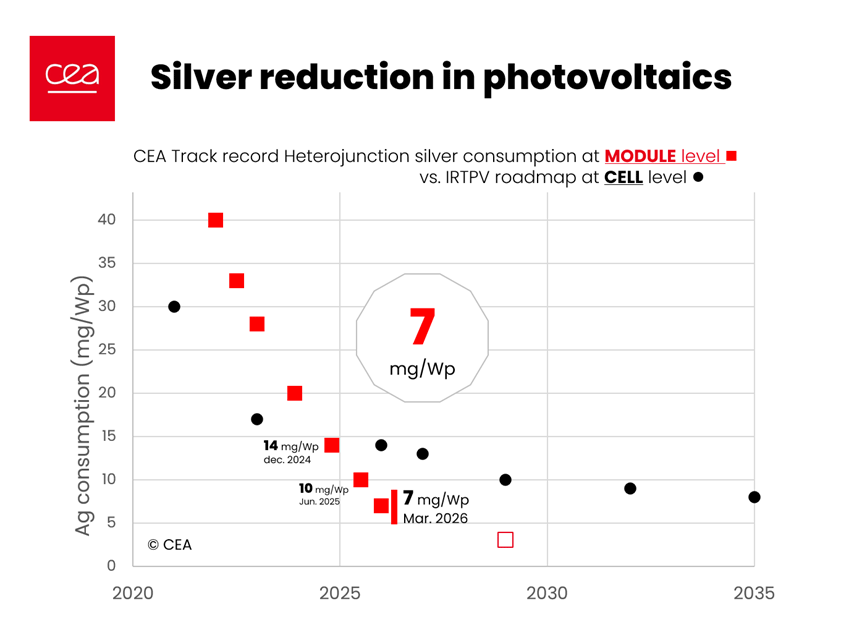
The photovoltaic industry set a target of reducing the silver consumption required to manufacture a photovoltaic cell to 5 mg per watt-peak (mg/Wp) by 2035.[1], [2] This target relates to the manufacture of the cell alone.
The technology of interconnecting solar cells using electrically conductive adhesive (ECA) represents a promising solution. It is a low-temperature, low-stress process, free of lead and bismuth. ECA bonds the ribbons/wires to the solar cells, or connects the cells themselves in shingle configurations. This technology, which has demonstrated excellent reliability in accelerated ageing tests and under outdoor conditions, has proven its value, particularly for the interconnection of temperature-sensitive heterojunction cells. Interest in ECA interconnection is also expected to grow further in the coming years, notably due to its compatibility with novel Si/perovskite tandem cells.With this technology, solder pads and even busbars are not required, which significantly reduces the amount of paste deposited on the cell. However, the amount of ECA used for interconnection remains high, and it is on this stage of the manufacturing process that research is focusing in order to reduce silver consumption. However, it has been shown that reducing the amount of ECA deposited on the cell can compromise the reliability of the photovoltaic panel. Therefore, the preferred approach to reducing the amount of silver in the interconnection process, without affecting reliability, involves the use of uncoated copper ribbons and ECAs with a lower silver content.
In recently published work, we have used commercially available ECA with a low silver content and have also developed ECA based on copper particles coated with a thin layer of silver to prevent oxidation.
By introducing an all-copper metallization on the back of the heterojunction cells, the total amount of silver in the panel has been reduced to 7 mg/Wp. Our result relates to the panel as a whole—that is, the cells and their interconnection—further highlighting our teams' lead in addressing these resource and competitiveness challenges.
|
A scientific article details our latest findings regarding the reduction of silver consumption in ECA interconnections for heterojunction solar cells.
Performance and reliability assessments were carried out on heterojunction panels manufactured using various combinations of copper-based metallisations, ECA and ribbons. Initial tests, carried out using uncoated copper ribbons, silver-copper metallized cells and low-silver-content ECA, achieved a total silver consumption of less than 14 mg/Wp. The results show that panels with silver-coated ribbons degrade more slowly than those with uncoated copper ribbons. However, the low-silver solution demonstrated good resistance to degradation by humid heat (DH) and thermal cycling (TC), with a relative power loss of less than 3% after 3,000 hours of DH and 600 TC cycles.
In further reducing silver usage, an all-copper metallization was applied to the rear of the cells, resulting in a total silver consumption of 7 mg/Wp in the panel. However, the hybrid Cu-Ag/pure Cu metallization configuration exhibited greater power degradation (>4%) after 1,000 hours of DH due to oxidation of the metal lines. To address this, future panels will incorporate an edge sealant.
Furthermore, the development of copper-based ECA is underway to further reduce the use of silver. Core-shell copper-silver particles with high oxidation resistance have been tested as conductive fillers, demonstrating electrical resistivities comparable to those of commercial ECA.
In summary, substantial progress has been made in reducing silver consumption in photovoltaic panels, achieving a total silver consumption of 7 mg/Wp through a bismuth- and lead-free interconnection process, while paying particular attention to reliability.
This research, carried out within the framework of the Institute for Energy Transition INES-Technologies (formerly INES.2S), is of particular interest to our industrial partner Mondragon Assembly.
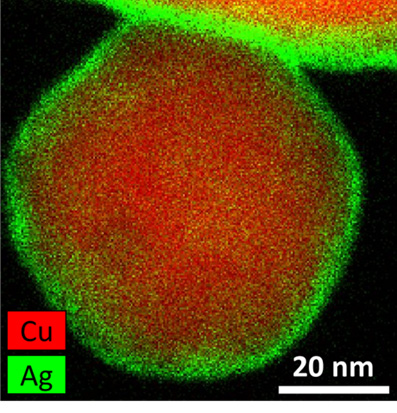
SEM-EDX observation of core-shell particles, Copper core and silver shell, synthetized at CEA
Credit CEA / Nathalie Ronayette PhD Thesis / 2025
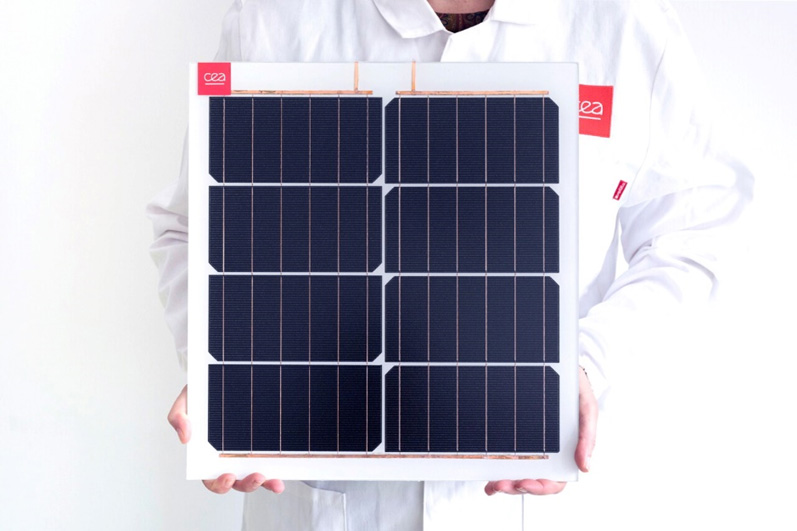
Demonstration of a mini-module with 14 mg Ag/Wc – credit: L GODART, CEA