With close to
30 million tons produced worldwide each year,
polyurethanes (PUs) are one of the most widely used classes of polymers. Around
60% of these PUs are
rigid foams, mainly used for building insulation, or
flexible foams for the furniture and transport sectors, while the remaining 40% are primarily found in
adhesive and paint. Despite their exceptional technical performance, PUs are
petroleum-based and synthesized using
toxic isocyanates (compounds subject to increasingly strict restrictions under
REACH) and are also very difficult to recycle. [1] Finding alternatives is therefore essential.
Development of innovative recycling solutions key to managing existing PU waste
The amount of PU waste produced is staggering, estimated at 1.6 million tons per year for flexible foams (such as mattresses and car seats) and approximately 1.3 million tons per year for rigid foams (thermal insulation). PUs are thermosetting materials, which makes them difficult to recycle, and the majority of this waste is either incinerated or landfilled (220,000 tons of PU foam sent to landfill each year [2]). At best, certain chemical recycling processes (e.g. solvolysis) allow 20 to 30% of the recycled material to be reused in new formulations, although this comes with significant energy costs. To tackle this problem, CEA-Liten is exploring mechanochemical solutions that minimize the environmental impact of recycling, by reproducing foams using conventional plastic processing methods. Instead of completely depolymerizing the material into monomers, as with chemical recycling, the process developed activates the reversibility of urethane bonds (using catalysts), while partially de-crosslinking the network, allowing sufficient molecular mobility for remolding via a melting process. This material can thus be remolded using standard plastic processing methods (such as extrusion or injection molding). This is followed by a foaming stage, as well as an adjustment of the cross-linking to obtain the final recycled foam. This process has demonstrated very promising results, with higher ratios of recycled content than chemical methods (up to 90% by weight). The recycled foams produced are similar in density and rigidity to the rigid PU foams used as insulating material in construction. This research has demonstrated the feasibility of recycling and repurposing polyurethanes from industrial production waste. This process could also be used on end-of-life PUs from various sectors, including the automotive or construction industries.
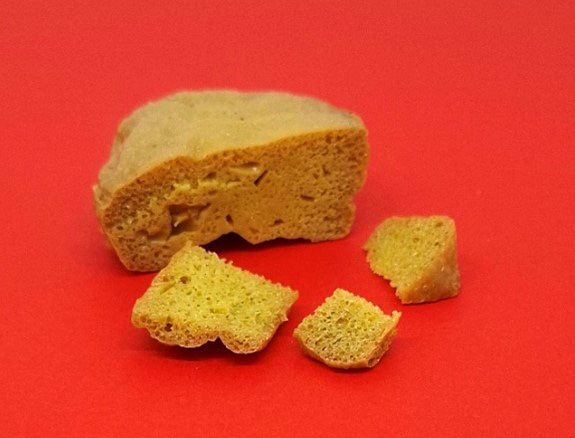
PU foam recycled via a mechanochemical process
Beyond existing solutions for PU recycling, the development of bio-based, isocyanate-free flexible foams should pave the way for more sustainable PUs.
Isocyanates play a key role in PU synthesis: they react with polyols to produce the urethane group, which forms the basis of the polymer chain. In foam manufacture, they can also react with water to form CO2 or with amine groups to create urea bonds that increase the rigidity of polymers. Highly reactive and versatile, they enable rapid polymerization with adaptable physical properties. However, their use comes at a price, as isocyanates can be hazardous for health: repeated exposure to low doses can cause allergies, asthma, or dermatitis, and high levels of exposure can result in acute toxicity (including pulmonary edema or eye damage). The 2024 European Regulation [3] has imposed lower occupational exposure limits for isocyanates and encourages the use of alternatives wherever possible.
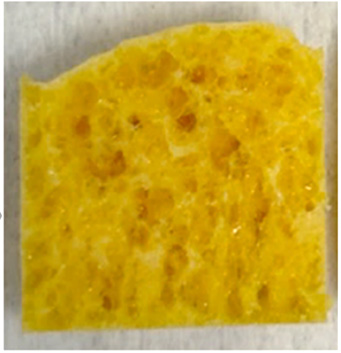
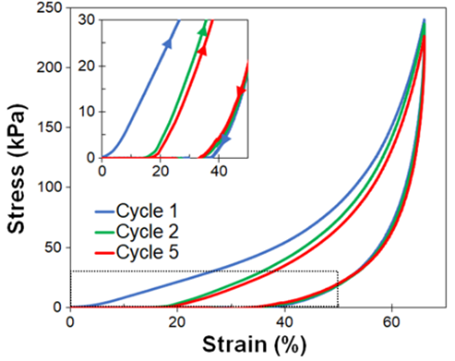
Since 2020, CEA-Liten has been working to develop isocyanate-free solutions, with promising results. The alternative chemical syntheses developed, using a non-food vegetable oil and bio-based blowing agents, have produced PU foams with mechanical properties similar to standard flexible foams. These results were achieved using curing times in line with industrial production rates.
| 
| 
|
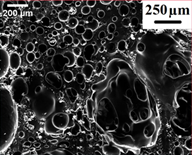
Left: PU foam sample manufactured via an isocyanate-free chemical process; Center: SEM image of porosity; Right: compression/decompression tests performed on isocyanate-free PU foam. Credit: CEA
|
Published in the journal
ACS Sustainable Chemistry & Engineering [4], these results show that
more sustainable PU foams can be produced to meet the performance requirements of the automotive sector.
Future prospects: While the kinetic properties obtained via this work show promise for industrial processes, they are not yet at the same levels as standard PU. Future research will therefore focus on improving these properties.
Applying expertise and resources to support the circular economy
By combining
chemical innovation,
process expertise and material analysis, CEA-Liten is contributing to the development of
more sustainable polymer materials, while accelerating the shift to a more eco-friendly industry. These advances are driven by its complementary strengths, both in terms of human expertise and technological infrastructure. The team is made up of chemists specializing in polymer synthesis, process experts, and specialists in materials characterization, thus covering the entire value chain, from molecule to final material. Their research draws on Green
Chemistry and Processes for the environment Platform, as well as CEA's cutting-edge characterization equipment, including the
NanoCharacterization Platform.
This research was conducted for the DECORE project (funded by the French government under the Investments for the Future Program (PIA) – PSPC CORAM AAP 1), and with the company Forvia, for PU foam used in the automotive sector, and as part of the European SURPASS project (https://www.surpass-project.eu/) for PU from the construction sector. The SURPASS project was financed by the European Commission’s Horizon Europe program, under Grant Agreement no. 101057901
Publications :
https://doi.org/10.1021/acssuschemeng.5c10064