In a wide range of sectors, including the food, paper and textile industries, processes release large amounts of energy at temperatures too low to be directly reused. Nonetheless, increasing the temperature of this “waste" heat, typically released at around 80°C, is an effective way of boosting energy efficiency. Precisely for this purpose, CEA-Liten has developed absorption heat transformers that operate via a closed-loop energy system. “In a sense, we're recycling thermal waste: from waste heat at 80°C, the machine produces usable heat at over 100°C, while only consuming a tiny amount of electricity," says Hai Trieu Phan, a researcher at CEA-Liten.
An ammonia-water mixture was used as the working fluid for the prototype in this study. Unlike standard mechanical compression heat pumps (which are highly energy intensive), this system uses thermal compression based on ammonia absorption and desorption in water. Under high pressure, ammonia vapor is reabsorbed into water via an exothermic reaction that produces heat at over 100°C. The cycle pumps consume only a tiny fraction of this energy, with an electrical coefficient of performance of approximately 30 under optimal conditions.
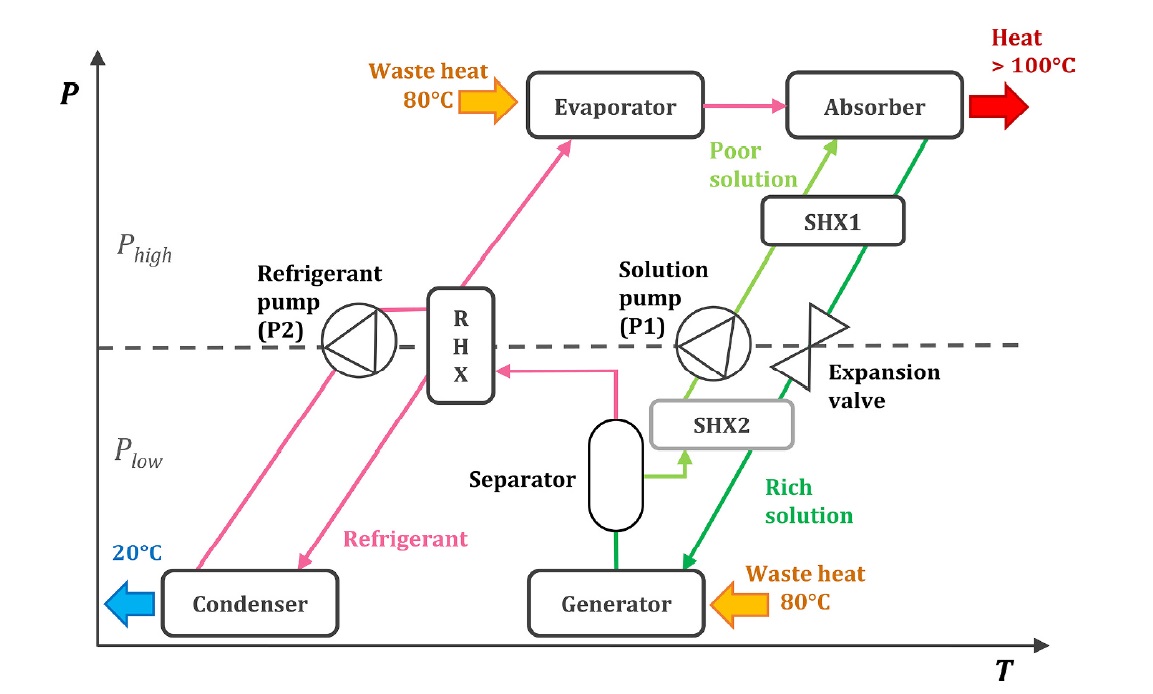
Process architecture
of the absorption heat transformer, represented in a P-T diagram showing medium
temperature waste heat converted into higher temperature heat, with NH3 desorption
and absorption occurring at low and high pressure, respectively.
This 10 kW laboratory prototype comprises a generator, condenser, evaporator, and absorber, but notably uses plate heat exchangers, which are compact components that are widely commercially available and designed to facilitate industrial scale-up in the future.
The experimental study, published in Applied Thermal Engineering*, enabled detailed characterization of the prototype's behavior over more than fifteen hours of stable operation, by varying the cold source temperature, the absorber inlet temperatures, and the heat transfer fluid flow rates. It has identified a key parameter: the flow rate ratio of the ammonia refrigerant and the ammonia poor-solutions circulating inside, which directly impacts performance, but also depends on the prototype's mechanical design and the volume of fluid in the system. “The purpose of this study was not to break performance records, but rather to identify the boundary operating conditions and design aspects that could be improved," emphasizes Lucie Desage, research engineer and lead author of the publication.
These results confirm that performance depends as much on thermodynamics as on the system's design and control strategy. The control strategy for the machine remains a key challenge: at present, it still largely depends on the operator's experience and has thus been identified as a priority area for improvement by the researchers. Future research will focus on dynamic modeling of the system and optimization of the control strategy prior to scale-up and industrial use, in collaboration with industrial partners.