The majority of researchers involved in the
PEPR PEMFC95 project, which aims to increase the operating temperature of these systems, are working on new, disruptive technological advances in materials. CEA-Liten has taken on the role of materials integrator: “in parallel with and before the integration of new materials that have to be developed and provided by academic partners, we are pushing the boundaries in terms of PEMFC cell performance, by operating the system at 95°C with commercially-available components," says Arnaud Morin.
“This requires extensive expertise in fuel cells and how they work."
Global state-of-the-art performance with a laboratory cell
Responsible for optimizing MEAs, the Grenoble team is focusing on electrodes, which are known to play a key role in electrochemical performance. Following three years of research, the team's results are conclusive: a 50% increase in performance under conditions representative of heavy transport applications (trucks, semi-trailers, etc.).
“We are setting new global standards in performance, as established by the American Million Mile Fuel Cell Truck project," says Christine Nayoze-Coynel, who is also involved in this research.
“This has been achieved using commercial components, rather than materials under academic study, developed on a small scale."
Experimenting with ionomer properties, quantities and chemical structure
These components are used in the inks for manufacturing electrodes. First, the ionomer: CEA-Liten's research verified that under conditions representative of the system's operation at 95°C, the short side-chain version largely surpassed the long side-chain version, both in terms of performance and degradation following the test.
The quantity of ionomer in the active layer was also studied: tests demonstrated the benefit of reducing the quantity at the anode and increasing it at the cathode. Lastly, the team assessed various solvents and obtained the best performance by mixing two of them in an aqueous base.
Optimized MEAs ready for industrial testing
“This research is not based on models and equations," adds Arnaud Morin, “but rather an approach guided by practical knowledge, trial and error, and multi-criteria comparisons between different combinations. We can now provide our industrial partners with optimized MEAs that can be used for testing at 95°C."
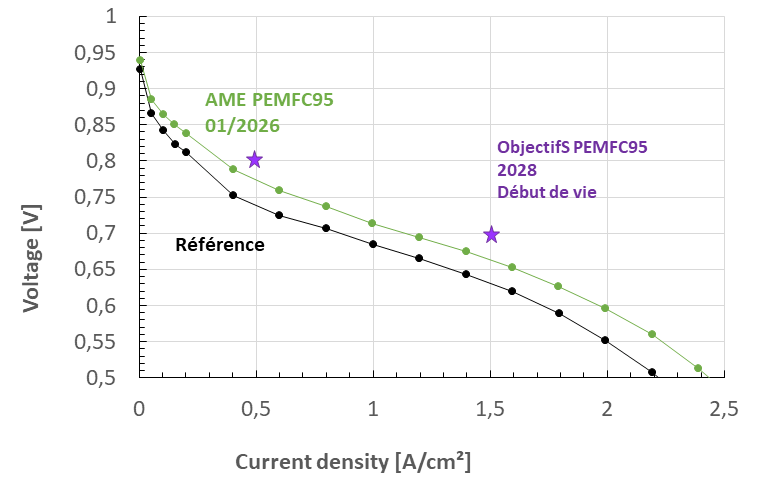
Comparison between the performance of a 100 cm² technical single cell and that of the MEA developed by the CEA using commercially-available materials and components, and the benchmark under representative conditions: 95°C_H2/Air_2.5/2.5 bar_28/17%RH.
The researchers did not only run these tests with cells measuring a few cm2: they reproduced their “recipes" in a 100 cm2 cell designed to be representative of a real cell. Conclusion: the ionomer (type and quantity) and solvents selected ensure optimal performance, both under nominal conditions (95°C, relative humidity below 28%) and transient conditions where these values are significantly exceeded.
“We have begun to assess the durability of our MEA at 95°C over accelerated degradation cycles of several hundreds of hours," explains Christine Nayoze-Coynel.
“We continue to target performance gains: we still need to achieve a 30% increase to meet the industry's requirements."