Triggered by an internal short circuit with various causes (mechanical shock, incorrect charging, aging, etc.), thermal runaway in a battery cell leads to a sudden increase in temperature, with the release of incandescent particles and gases that can exceed 1,000°C: hydrogen, carbon monoxide, carbon dioxide, etc. The cell can ignite in a single second, causing the thermal runaway to spread to the surrounding cells, thus setting of a chain reaction.
Simulations and abuse testing
This chain reaction has been the subject of extensive industrial and academic research. The research conducted by CEA-Liten for the European Versaprint project had two objectives: limit the impact of thermal runaway events and reduce the likelihood of fire outside of the battery module. “We focused on two key mechanisms" says Remy Panariello, a researcher on the project: “channeling the gases expelled by the cell toward the outlet of the module and reducing their temperature."
The researchers built two test modules, each containing three commercial 51Ah cells commonly used in vehicles, as well as the exhaust gas management system developed within Versaprint. Simulations were run on this system, led by the German institute RWTH (which was also involved in the design), and two tests were carried out via the CEA's battery abuse testing platform.
“The system will be patented," states Gaël Berrier, another researcher at CEA-Liten who worked on the project. “It contains several metal alloys and moderately increases the volume and mass of the battery module, through its ingenious design." Most importantly, the system performed as intended: no gases ignited during the two abuse tests, as predicted by the simulation.
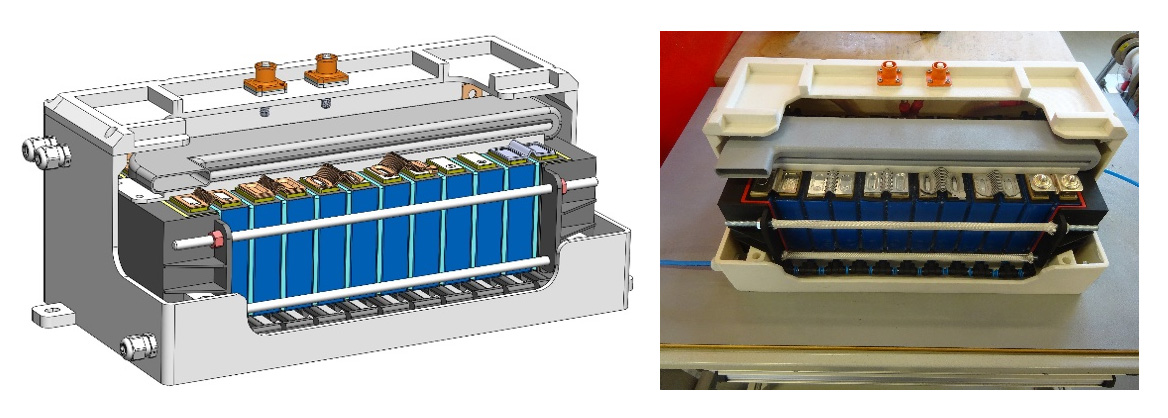
System design by CAD, on the left, and photo of the demonstrator intended for testing on the CEA's battery abuse testing platform on the right.
Credit: CEA
Gas, incandescent particles, but no fire
In the first test, the trigger cell was heated for 20 minutes (6°C/minute) without using the cooling channels. This slow rise in temperature also preheated the two neighboring cells, triggering them into thermal runaway as well. The exhaust gas system allowed for the majority of incandescent particles to be blocked.
In the second test, the temperature was increased at double the rate (12°C/min) and the cooling channels were activated. The CEA-Liten system fulfilled its intended function: it cooled the 1,100°C gases emitted by the cell under thermal runaway to 550°C, while preventing the incandescent particles from igniting when exiting the module. Moreover, the exhaust gas system also allowed the thermal runaway not to spread to the surrounding cells.
“There is still work to be done to substantiate these initial results," warns Remy Panariello. “Particle filtration needs to be more efficient. We need to refine the gas management system concerning materials and thicknesses, as in this first stage of development, we used considerable safety margins, etc."
The researchers would also like to conduct an R&D project with an industrial partner, using their specifications. Finally, in the coming months, some of the system's components will be integrated into a battery module for aeronautical use and subjected to testing.