Science, and in this case operational research, is the right way to support market players, as it involves determining the optimal solution to a planning problem under constraints.
In responding to these needs, the CEA has been developing
More for several years, a library of components that is structured, modular and extensible in a language specifically dedicated to optimization under constraints, which is neutral with regard to the solvers used. Here, we invite you to learn about this toolkit and discover some of its applications.
As markets have gradually opened up, new opportunities have emerged, ranging from energy markets, such as SPOT and PPAs, to flexibility markets – adjustment mechanisms, capacity markets, primary, secondary, fast or complementary reserve markets – to CRE tenders and the carbon quota market. There are therefore many opportunities, but at the cost of increasing the overall complexity of the system with the introduction of market rules, network codes, laws and regulations, public policies, new players, new uses and means of production.
Planning the means of production or storage that a player must announce to the network operator the day before for the following day, known as the Call Programme, is a complex task. It involves different objectives, requires arbitration between participation in different markets, and must comply with numerous constraints: those relating to technical means of production, storage or consumption, those associated with the network operator's rules, those required for market access, etc.
The CEA at INES has been partnering with various industry players for many years, ranging from network operators to major energy companies and producers/operators of all sizes. It has implemented an agile R&D strategy that takes into account the rapid and constant changes in the energy landscape and enables it to capitalise on these developments.
which is neutral with regard to the solvers ultimately used.
Our researchers develop these models in a structured, modular and extensible manner, and group them together in a component library.
This library is a key tool:
- It consists of models developed using explainable, reliable and auditable processes;
- It can be used as a tool to help build market offers;
- Integrated into a simulation tool, it is a building block for developing, evaluating and testing an operational Energy Management System (including planning, energy management and power management) that can be deployed in the field.
The methodology used is based on the development of models in a language specifically designed for optimization under constraints.
Examples of how this library has been used to meet the needs of industrial partners:
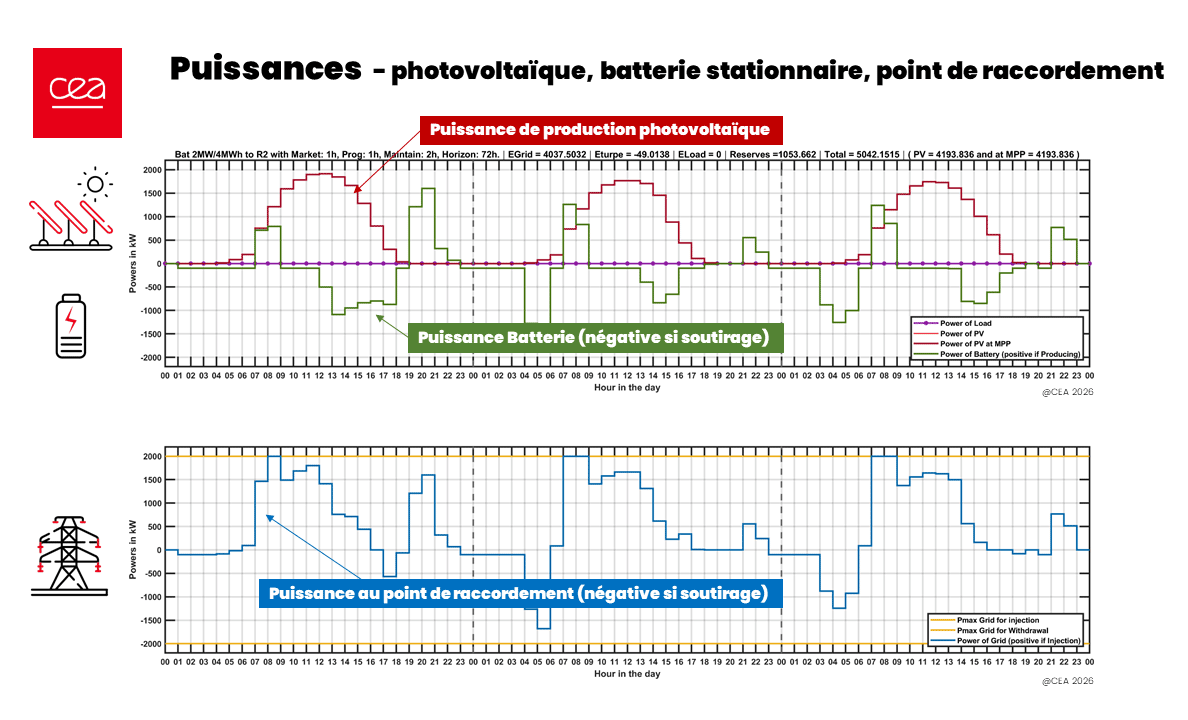
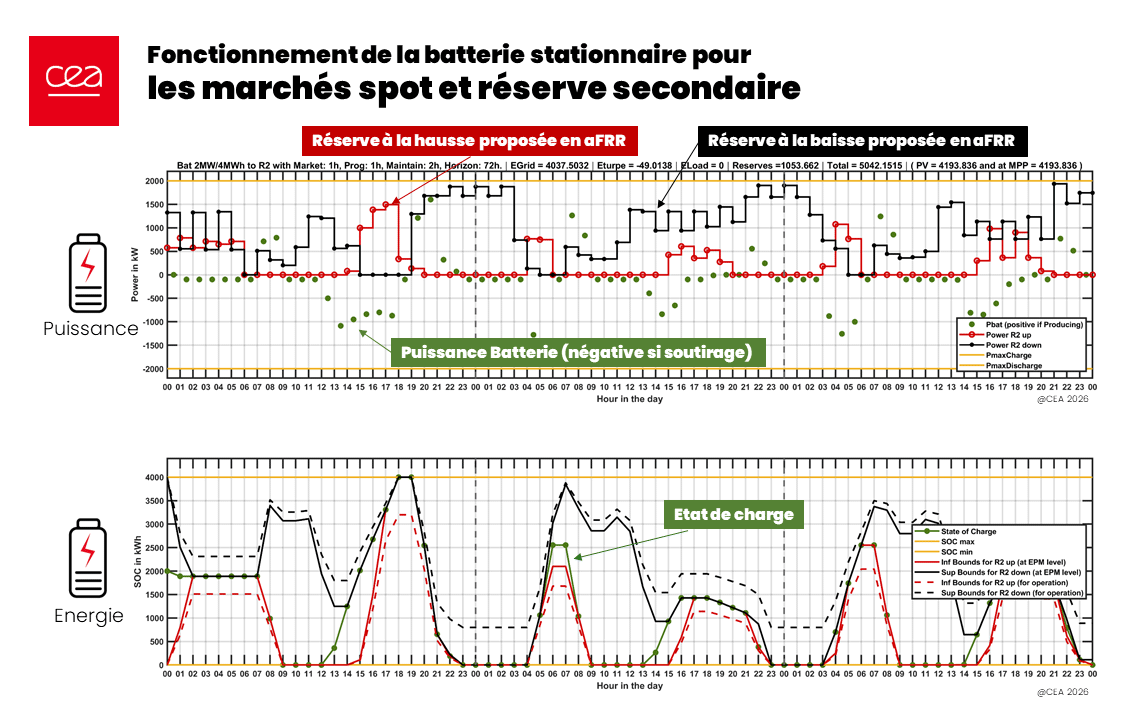
- Participation of a battery in SPOT markets and primary and secondary reserve markets for a system consisting of photovoltaics and batteries (see CASE STUDY)
- Control of the interior temperature of a building, ensuring the thermal comfort of occupants while being subject to electricity pricing indexed to SPOT market prices
- Participation of a hydrogen production unit in primary and secondary reserve markets
- Control of a photovoltaic power plant equipped with battery storage subject to the requirements of CRE tenders in non-interconnected areas
Curious to find out how our researchers could help you optimise your operations and business?
These tools and methods are being developed as part of the INES.2S ITE, which receives French government funding under the Investments for the Future Programme (ANR-10-IEED-0014-01).
CASE STUDY - Participation of battery storage in SPOT markets and primary and secondary reserve markets for a photovoltaic & battery system
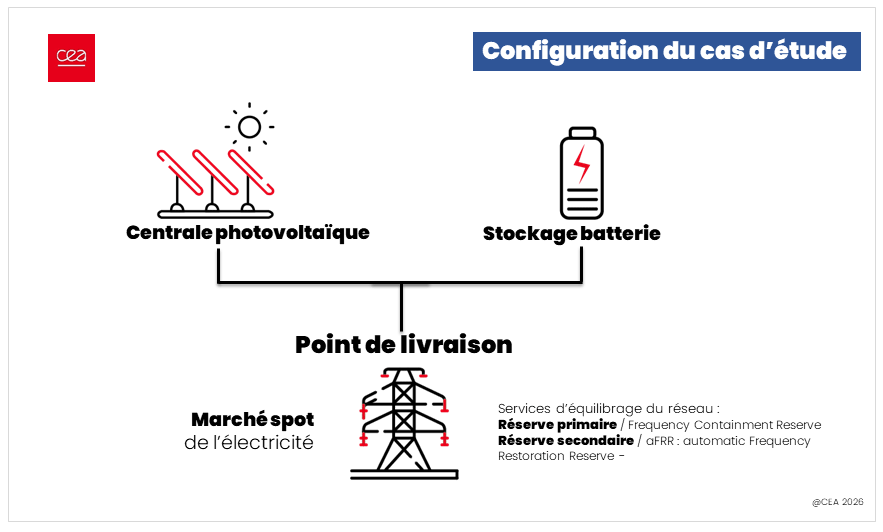
In this study, our researchers optimize the supply of energy produced and/or stored on spot markets and in services for the grid, taking into account all technical and market constraints. For example, the tool generated in this case constrains the battery's state of charge so that at any given moment, the battery can maintain the supply of the entire secondary reserve for at least two hours. It ensures that the expected power levels can be achieved at any given moment if all reserves are called upon. It also limits the number of cycles performed by the battery in order to preserve its service life.