Optomechanical sensor
Mechanical sensing through light for extreme sensitivity, ultra-rapid response, and superior integrability
CEA-Leti’s optomechanical sensors represent a technological revolution compared to conventional sensors. This new generation of optomechanical sensors developed by CEA-Leti combines silicon photonics and high-performance MEMS. Inside this CEA-Leti technology, an electromechanical sensor is combined with an optical cavity. Instead of generating an electrical signal like a conventional MEMS sensor, a moving mass generates an optical signal of varying intensity enabling precision measurement.
This principle enables a variety of novel sensing applications, such as the detection of even very tiny objects, the measurement of mass, imaging with a high enough frequency for real-time microscopic observation, and precision silicon reference clocks.
What it can do
- Portable biological sensing offering rapid biomarker detection and sensitivity down to single bacteria for diagnostics.
-
Portable in situ mass spectrometry with extreme sensitivity for the observation of viruses and proteins (in vitro diagnostics) particles (environmental monitoring).
-
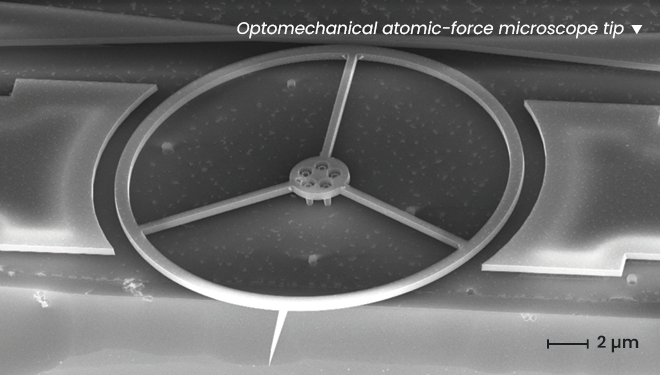
Real-time atomic-force microscopy (AFM) approaching video-rate imaging for the observation of fast biological processes.
-
Silicon reference clocks with extreme accuracy through native GHz-frequency oscillators with no electronic multiplication for the ultimate in precision timing.
The technology is also being investigated for
quantum information transfer and
micro-rheology and brings new levels of precision and compactness to inertial sensors.
|
|
What makes it unique
Optomechanical sensing - sensing through light - is a new paradigm. And silicon-based optomechanical devices represent a giant leap in performance, with:
-
Extreme sensitivity: femtometer (1/100,000th of an atom) detection capabilities.
-
Ultra-rapid response in the terahertz range.
-
Superior integrability using proven 200 nm VLSI MEMS and photonic integrated circuit technologies. The same multiplexing techniques used in optical telecommunications could lead to multiplexed optomechanical arrays for multiple measurements on a single chip.
|
Working with CEA-Leti
Following these chip-level developments, CEA-Leti is now working on a compact system-in-package (SiP) with the optical function and readout electronics. CEA-Leti’s optomechanical sensing technology is of interest for high-precision clocks, chemicals, materials, and biology, where it can enhance cellular detection and high-resolution imaging.
Companies looking to develop innovative sensors can work with CEA-Leti, benefiting from the institute’s expertise in R&D partnerships and intellectual property, from idea through to commercialization.
Scientific publications
- Sansa, M., et al. (2020). Optomechanical mass spectrometry. Nature Communications 11.
- Marković, A., et al. (2024). Suspended tip overhanging from chip edge for atomic force microscopy with an optomechanical resonator. JOM, vol. 4, no. 3, p. 033501, Sep. 2024, doi: 10.1117/1.JOM.4.3.033501.
|