A TECHNIQUE INSPIRED BY SEISMOLOGY
Magnetic resonance elastography (passive MRI elastography, pMRE), which assesses tissue elasticity and viscosity, is inspired by noise correlation tomography concepts used in seismology. pMRE uses the natural vibrations of the human body (shear waves), such as those induced by heartbeats or respiratory movements, to measure the wavelength of shear waves directly related to the stiffness of tissues or organs. This new, non-invasive elastography imaging technique, also known as 'palpation imaging,' is well tolerated by patients since it does not require an external shear wave source, such as an external vibrator used in conventional MRI elastography.
SEVERAL POTENTIAL CLINICAL APPLICATIONS
In this study, the authors designed and developed an innovative pMRE sequence as part of a clinical trial conducted on 18 patients with different types of brain tumours (12 with malignant tumours ; 6 with benign tumours). They compared the pMRE results with the parameters measured by ultrasound elastography during surgical resection of the tumour and found that the wavelength values of the tumours obtained by pMRE were significantly correlated with those obtained by echography (US). Interestingly, pMRE made it possible to distinguish between malignant and benign tumours, by wavelength measurement.
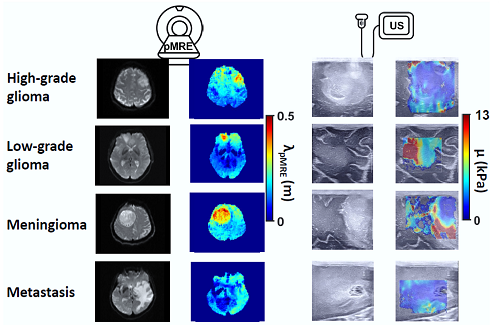 © Pagé et al., JMRI, 2025
These results show that pMRE is likely to provide crucial information for early detection, surgical planning, treatment monitoring or understanding tumour processes. In the context of oncological challenges, the passive elastography approach presented in this study is sensitive, does not add any technical difficulties compared to a standard examination, and is more comfortable for the patient than a conventional MRI elastography examination.
Joliot contacts : Jean-Luc Gennisson (jean-luc.gennisson@universite-paris-saclay.fr) ; Gwenaël Pagé (gwenael.page@cea.fr)
Noise correlation tomography. In wave physics, and particularly in seismology, scientists use “noise correlation" algorithms to extract meaningful information from random background vibrations. This technique reconstructs coherent wave signals and enables imaging without active sources, paving the way for innovative passive imaging methods.