METABOLOMICS : GOING BEYOND THE LIMITS OF CLASSICAL APPROACHES
Understanding how diet, drugs, toxic compounds, or disease disrupt metabolism remains a major challenge. Until now, metabolic studies have largely relied on targeted isotopic methods, often radioactive, which consist of tracking a specific precursor within a given metabolic pathway, an approach that is “effective, but limited…," points out Annelaure Damont (SPI/DMTS), first author of the study, who continues : “…because it assumes prior knowledge of which biological pathways are affected. Yet the effects of a treatment or a pathology can be multiple, unexpected, and sometimes far removed from the initial target."
The ambition of this work was to broaden the ability to observe metabolism globally and without prior assumptions by labeling all carbon-containing molecules in an organism, thereby generating an isotopic map of metabolism. This represented an extraordinary challenge, which the authors addressed thanks to a conceptually simple but technically demanding idea: newborn mice were fed for six weeks with a mixture of ¹³C-labeled spirulina and ¹³C-labeled wheat flour, corresponding to a diet whose carbon content was enriched to 97.2% in ¹³C, a stable and non-radioactive isotope of carbon. While ¹³C-labeled spirulina is commercially available from a few fine-chemicals suppliers, the production of ¹³C-labeled wheat proved far more complex and required the expertise of the Phytotec platform, specialized in plant cultivation under controlled atmospheric conditions (see box).
The ¹³C-fed animals developed normally, and their urine was collected daily. Three control mice were treated in the same way but received a non-enriched diet. Metabolomic analyses and isotopic tracing were performed on urine samples by high-resolution mass spectrometry (SPI/DMTS, see box). Comparative analysis of the ¹²C and ¹³C samples enabled the unambiguous identification of 238 metabolites, whose ¹³C-labeling profiles were subsequently monitored over a 39-day period. The authors observed that numerous metabolites reached labeling levels exceeding 90% in ¹³C.
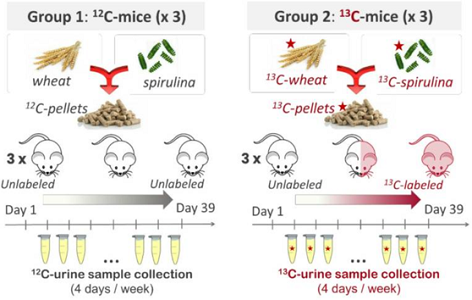 Protocol for in vivo 13C labelling.
© Damont et al., Metabolomics, 2025
| 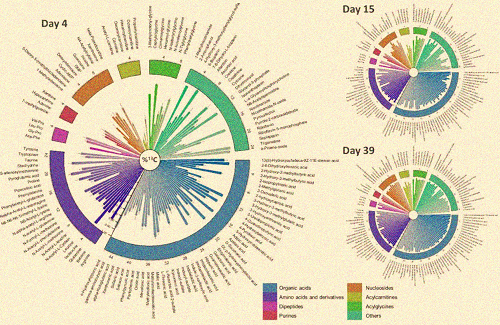 Circos representation of the 13C content of the 128 metabolites identified at 4, 15 and 39 days
|
By demonstrating not only that mice can tolerate a ¹³C-labeled diet for nearly six weeks, this study also reveals the dynamics of a large fraction of the metabolome in a reliable and robust manner. It provides valuable information that comprehensively covers metabolic pathways, in contrast to targeted approaches, and represents an unprecedented methodological achievement.
POTENTIAL IMPACTS IN MEDICINE AND TOXICOLOGY
Nutrition, toxicology, and pharmacology: the potential fields of application of such an approach are numerous. Ultimately, the use of fluids or tissues fully labeled with ¹³C could make it possible to detect metabolic disorders more precisely and quantitatively from a simple blood, urine, or biopsy sample taken from a living organism. It would offer the opportunity to simultaneously identify both the expected effects of a drug and its unwanted side effects, as well as to characterize the overall impact of a diet or an environmental toxin.
This work would not have been possible without the close collaboration between researchers from BIAM and DMTS (Joliot). All the results obtained highlight, if proof were still needed, the importance of fundamental research, without which applied research could not exist. By demonstrating that a whole-body isotopic labeling is both feasible and exploitable, the scientists provide their community with a tool that makes it possible to envision new applications for a better understanding of living systems.
Joliot contacts : Annelaure Damont (annelaure.damont@cea.fr) ; Éric Ezan (eric.ezan@cea.fr) ; François Fenaille (francois.fenaille@cea.fr)
-
Metabolomics is a relatively young discipline that aims to analyze the full set of
small organic molecules (<1500 Da), known as
metabolites, produced by metabolism and present in a given biological environment (blood, urine, saliva, cells, tissues, etc.). It relies in particular on
mass spectrometry and currently makes it possible to detect hundreds of metabolites in a single sample. To make metabolomics quantitative and reliable, scientists add
reference standards labeled with stable isotopes to the samples to be analyzed. In the present study, a major technical achievement was accomplished: using “¹³C-enriched" animals, it became possible to produce
natural biological standards covering a wide range of metabolic pathways at the scale of an entire organism.
- The
PHYTOTEC platform, integrated within
BIAM, possesses unique expertise in France in plant cultivation under controlled atmospheres, capable of
enriching plants to very high levels with stable isotopes, particularly carbon-13 (¹³C) and nitrogen-15 (¹⁵N), and producing biomass that is heavily and uniformly labeled, with enrichment levels exceeding 95%. This is how the animals in this study were able to
receive a diet composed of a mixture of :
i) flour derived from
¹³C-labeled wheat, sown and cultivated over six months in a sealed chamber in which 99% of the CO₂ atoms introduced from the start of cultivation were ¹³C-labeled, and
ii) ¹³C-labeled spirulina, obtained from the company Eurisotop. For comparison, the CO
2 in the air we breathe contains approximately 1% ¹³C, the remainder being ¹²C.
- The urine samples from the ¹³C-labeled mice were analyzed at the
Innovations in Mass Spectrometry for Health laboratory of SPI (DMTS/Joliot), whose activity focuses on the development of
high-resolution mass spectrometry techniques for biomedical research in the context of industrial and academic collaborations. The SPI mass spectrometer facility is part of the Métabolome-IDF platform, certified by IBiSA, which itself is an integral part of the
MetaboHUB Infrastructure.