BRAIN MAPPING OF COGNITIVE FUNCTIONS : NOT SO SIMPLE...
Brain magnetic resonance imaging has provided valuable insights into how the human brain functions. In particular, large cohorts of individuals have been scanned using functional MRI (fMRI) while performing a variety of tasks (visual, auditory, language-related), with the aim of using the resulting functional connectivity (FC) data to map the cortical regions involved in processing specific stimuli or carrying out particular cognitive functions. However, this endeavor must account for substantial inter-individual differences in brain anatomy and functional organization, making the study of large populations particularly challenging. In particular, the impact of the choice of FC measures on the representation of both subject-specific and task-related properties remains poorly understood. In other words, the functional connectivity patterns that uniquely characterize and identify an individual are not necessarily the same as those that distinguish the cognitive task being performed.
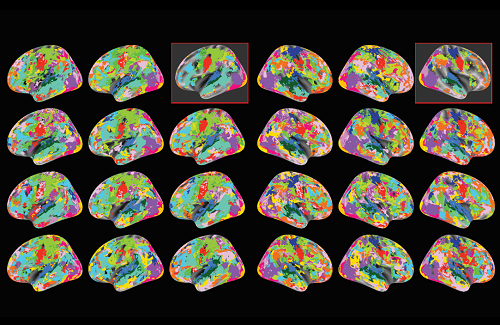
DECODING VISUAL AND AUDITORY SEMANTICS ACROSS INDIVIDUALS
In this study, the authors hypothesized that functional connectivity (FC) measures based on Pearson correlation are better suited for task classification, whereas partial-correlation-based measures are more appropriate for subject identification and more closely resemble structural connectivity (SC). To test this hypothesis, the researchers analyzed a high-quality deep-phenotyping dataset comprising several naturalistic tasks (story listening, viewing three different movies, playing a video game) as well as resting-state scans. They focused on two classification problems: subject identification (brain fingerprinting) and task classification. The performance of different combinations of two FC measures and three covariance estimation methods was compared, and the similarity and individual specificity of FC across tasks, as well as its relationship with SC, were subsequently examined.
The results showed that sparse partial correlation, estimated using the Graphical Lasso method, achieved the best performance for subject identification and exhibited the strongest similarity to SC. This measure therefore appears to be a particularly distinctive marker of individual identity. In contrast, task-related information was more effectively captured by Pearson correlation, as it reflects distributed patterns of brain activity. Overall, the authors found that the pairwise interactions highlighted by partial correlation are optimal for individual identification, whereas the multivariate relationships underlying full correlation provide a more accurate marker of cognitive function.
Partial and full correlations provide two complementary perspectives on brain organization. Partial correlation, which aims to highlight direct functional connections between brain regions, yields more accurate results for individual identification. In contrast, full (Pearson) correlation estimates capture both local and global patterns of functional connectivity, making them better suited for characterizing and distinguishing cognitive tasks.
Contact : Bertrand Thirion (bertrand.thirion@inria.fr)
- In statistics, the
Graphical Lasso is a penalized maximum-likelihood estimator of the precision matrix of a multivariate elliptical distribution. By applying a sparsity-inducing penalty, it regularizes the estimation process and produces a sparse precision matrix, facilitating the identification of direct relationships between variables.
- The
Pearson correlation coefficient, commonly referred to simply as the correlation coefficient, measures the strength and direction of the linear relationship between two sets of data.
- See also the results of the
team's previous studies