Published in
Nature Photonics in June 2026, this result comes from the European NEoteRIC project, led by the University of Valencia in Spain, with contributions from Swiss start-up Lumiphase, the University of West Attica, Spanish company iPronics, and CEA-Leti.
Toward a revolution in integrated photonics
With the rise of artificial intelligence, data centers need to handle ever-increasing volumes of data, pushing the limits of bandwidth and energy consumption of conventional electronic technologies.
An alternative approach is
silicon integrated photonics, an area that CEA-Leti has been exploring for more than 20 years. It uses light to transmit information through miniaturized circuits. By replacing electrons with photons, it enables higher data rates while consuming less energy.
Going further with a very special material
The same concept can be applied to replace transistors and perform computing operations.
“Our strength lies in photonic neuromorphic computing, which takes inspiration from the brain to design circuits that consume less energy and are faster and more compact," explains Benoît Charbonnier, research engineer at CEA-Leti.
This is the goal of the NEoteRIC project: to perform operations in the optical rather than electronic domain, such as
vector-matrix multiplication, a key operation in artificial intelligence.
“It all relies on the coherence of light, which makes it possible to control interference between light waves," explains Benoît Charbonnier. “These effects can then be harnessed to perform computations."
The objective was to provide a proof of concept by fabricating a processor integrating a key ferroelectric material,
barium titanate (BTO).
What makes it special? Unlike the solutions used to date, it does not require current to maintain its state, only a voltage.
As a result, energy consumption drops to
560 nanowatts per phase shift, representing a reduction of three, and potentially four, orders of magnitude compared with existing thermo-optic solutions, which consume between 1 and 10 milliwatts for the same function.
A flexible and versatile platform
Within this collaborative project, CEA-Leti's role was to provide its
silicon photonics platform to integrate this material, which is still relatively uncommon in industry.
“Our technology makes it possible to incorporate materials that cannot currently be integrated by major industrial players," says Benoît Charbonnier.
CEA-Leti teams initiated the circuit fabrication process, which was then completed by Lumiphase, the start-up behind the BTO solution.
This collaboration was made possible by the fact that CEA-Leti's platform is capable both of
experimenting with new processes and manufacturing at an industrial scale.
The potential of the photonic approach
For Éléonore Hardy, Head of Silicon Photonics Partnerships at CEA-Leti, this result addresses an important question.
“Demonstrating that energy consumption can be drastically reduced on a generic, reconfigurable architecture that can be deployed at large scale helps remove some of the uncertainties surrounding this technological approach," she says enthusiastically.
However, while the targeted applications primarily focus on
AI computing and reducing the energy consumption of data centers, use cases still need to be identified that will justify the industrial adoption of this emerging photonic neuromorphic approach.
In the meantime, CEA-Leti is continuing its research through the European
Prometheus and
Neuropuls projects, which aim to integrate additional functionalities onto the same platform, including
laser sources.
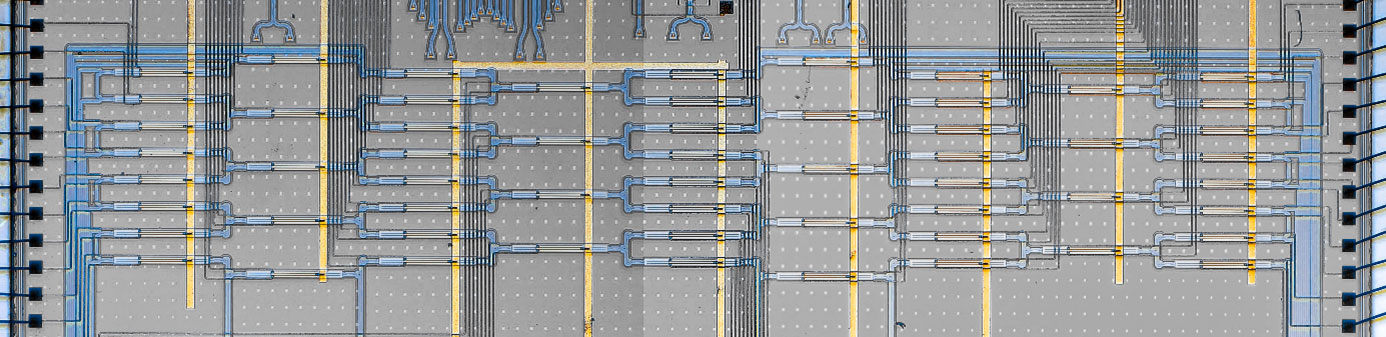
Zoomed-out microscope image of the fabricated hexagonal mesh, displaying the large-scale integration of unit cells and interconnected BTO actuators. E-field, electric field.
Credit @C.Catalá-Lahoz_Polytechnic_University_of_Valencia
More information in
Nature Photonics
https://www.nature.com/articles/s41566-026-01934-y