At the heart of augmented reality glasses and headsets are micro-displays measuring barely a centimeter across. These tiny displays can integrate millions of micro-LEDs, light sources only a few micrometers in size.
In particular, gallium nitride (GaN)-based micro-LEDs offer significantly higher brightness than current OLED technologies. This is essential for displaying information overlaid on glasses, even in bright ambient environments.
Integrating the three primary colors side by side
"We already know how to manufacture very small monochrome displays with a reduced pixel pitch," explains Marianne Consonni, Laboratory Manager in CEA-Leti's Optics and Photonics Department. "However, integrating the three primary colors - red, green and blue (RGB) - side by side at such a small scale remains a major challenge."
The Propolys teams therefore decided to explore an innovative approach: sequentially growing the structures emitting the three colors on the same substrate, rather than assembling several monochrome displays, as is currently done.
"This color-by-color sequential epitaxial growth process is an approach that remains relatively uncommon elsewhere," notes Bernard Aventurier, Head of Technology Integration at the laboratory.
A 100% CEA-Leti project
This strategy was made possible by combining a wide range of CEA-Leti expertise.
The project brought together around twenty researchers from four laboratories of the Optics and Photonics Department and the Technology Platforms Department.
"CEA-Leti's strength in this project was its ability to bring together all the expertise required - from materials development to their technological integration for micro-LED manufacturing, using equipment and processes compatible with industrialization," emphasizes Marianne Consonni.
This rare combination of complementary expertise enabled the teams to continuously fine-tune both the epitaxy and component manufacturing processes.
Promising results and validated technology building blocks
The results are particularly encouraging.
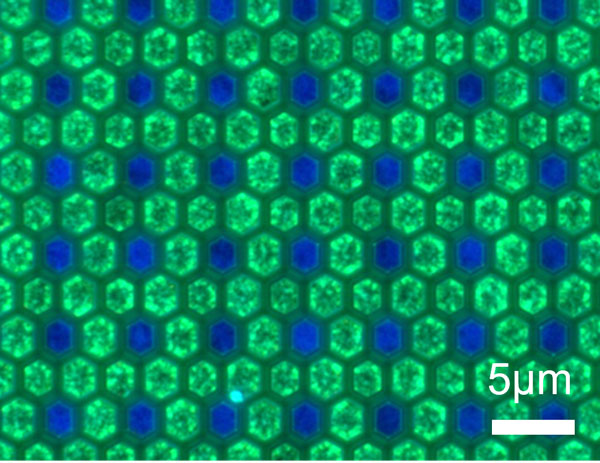
After four years of research, the teams successfully obtained blue, green and red emitters on a 200 mm GaN-on-silicon substrate. They also demonstrated several successive epitaxial growth sequences on the same substrate, producing blue and green emitters side by side with a 5 µm pixel pitch.
Most importantly, they developed an integration process compatible with the fabrication of a micro-display.
"We validated the entire process chain for this new approach and demonstrated the feasibility of this technology platform," says Marianne Consonni.
Toward a complete display and industrial transfer
This monolithic integration approach represents a key step toward future industrial developments in a market that is both highly promising and highly competitive.
However, developing a complete RGB display will require further progress.
"The next steps will focus on two main areas," explains Bernard Aventurier. "Improving material performance, particularly for red emission, and exploring alternative approaches that build on the expertise developed throughout the project."
The knowledge and expertise acquired through Propolys now provide a strong foundation for further development of full-color micro-LED displays and for establishing future industrial partnerships.
| 
|
|
| Photo caption: Fluorescence microscopy image of blue and green sub-pixels with a 5 µm pitch, fabricated by sequential epitaxy on a 200 mm GaN/Si substrate. |
|