You are here : Home > Research entities > DMTS > Molecular engineering for Heal ... > Laboratory of Cellular Immunology and Biotechnology

LICB

Laboratory of Cellular Immunology and Biotechnology

​Research at the Laboratory of Cellular Immunology and Biotechnology (LICB) focuses on the mechanisms and prediction of immunogenicity of therapeutic proteins and on the generation of therapeutic proteins by directed evolution systems.
Published on 26 March 2026


LAB LEADER

Bernard MAILLÈRE
+ 33 1 69 08 94 47
bernard.maillere@cea.fr


Over the past two decades, therapeutic antibodies have established themselves as a major class of medicines, primarily due to their ability to specifically recognize their target. Their clinical success, combined with technological advances in production and engineering, has led to a considerable diversification of their formats. Next-generation antibodies can thus be multispecific, single-chain, or conjugated to bioactive or cytotoxic molecules. The work conducted within the Cellular Immunology and Biotechnology Laboratory aims to design innovative antibodies by improving their recognition properties, optimizing their developability (expression, stability, and low aggregation), and limiting the undesirable immune responses they may elicit.


The immune system consists of complex networks of interactions between secreted proteins and proteins expressed on the cell surface. These proteins are encoded by germline genes or result, in the case of immunoglobulins and T-cell receptors, from random recombinations of multiple genes that generate a repertoire of diverse molecules capable of selective interactions. In humans, this repertoire comprises several hundred million different clones, which are partly selected to preferentially interact with foreign molecules (non-self) while avoiding reactions with our own molecules (self). However, this selection process is highly imperfect due to the complexity of the molecular representation of self. The mechanisms we study are largely a consequence of the composition of immune repertoires, and the directed evolution systems we use are essentially inspired by the immune system.


ANTIBODY ENGINEERING.


Team leader

Hervé Nozach
+ 33 1 69 08 42 15
herve.nozach@cea.fr


The Antibody Engineering team develops novel antibody-based ligands for a range of applications, including therapeutic, imaging, and diagnostic purposes. It focuses particularly on designing high-affinity antibodies with controlled selectivity and low immunogenicity, enabling administration in humans while minimizing the risk of immune responses. The team has developed protein molecular engineering tools that combine a high-throughput screening method, Yeast Surface Display, with high-throughput NGS sequencing technologies. In particular, it implements a Deep Mutational Scanning (DMS) approach aimed at identifying, within protein sequences, the key amino acids that play a functional role in the property of interest. DMS data notably help elucidate protein–protein interfaces (such as epitopes or paratopes). They are also used to guide the engineering of optimized molecules, particularly for affinity maturation or antibody selectivity engineering.
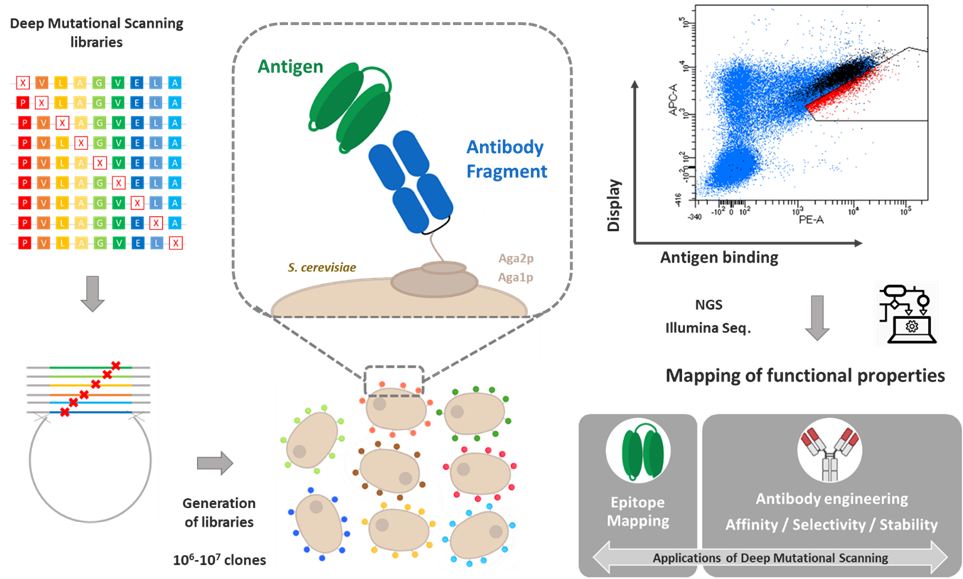
  

These technologies led to the creation of the antibody engineering service company Deeptope (http://deeptope.com).

We also conduct activities aimed at discovering novel VHH ligands from both synthetic libraries and immunization-derived libraries, in order to identify antibodies with optimized functional characteristics. In parallel, we develop artificial intelligence–based approaches designed to perform differential screening of antibodies according to their antigen-binding interface. These strategies, enable the selection of antibodies targeting specific epitopes and the achievement of precisely characterized and controlled modes of action. This work is carried out in the context of applications in oncology, in the fight against various emerging infectious diseases, as well as for agents of the CBRN-E domain.

Synthetic biology and evolution


Team leader

Oscar Ramos
+33 1 69 08 33 15
oscar.pereira-ramos@cea.fr


The “Synthetic Biology and Evolution" (SBE) team combines biomolecular engineering, synthetic biology, and generative artificial intelligence (AI) to design innovative biological systems and proteins. Our approach integrates high-throughput methods (multiplexed assays of variant effects, MAVE; NGS) and proprietary technologies such as in vitro DNA assembly (SLiCESBE) and bacterial genome engineering (bDICESBE). A core technology underpinning its activities is the qB2HSBE system (quantitative bacterial two-hybrid), which generates high-quality protein–protein interaction data ideally suited for AI model training and for accelerating multispecific antibody engineering.
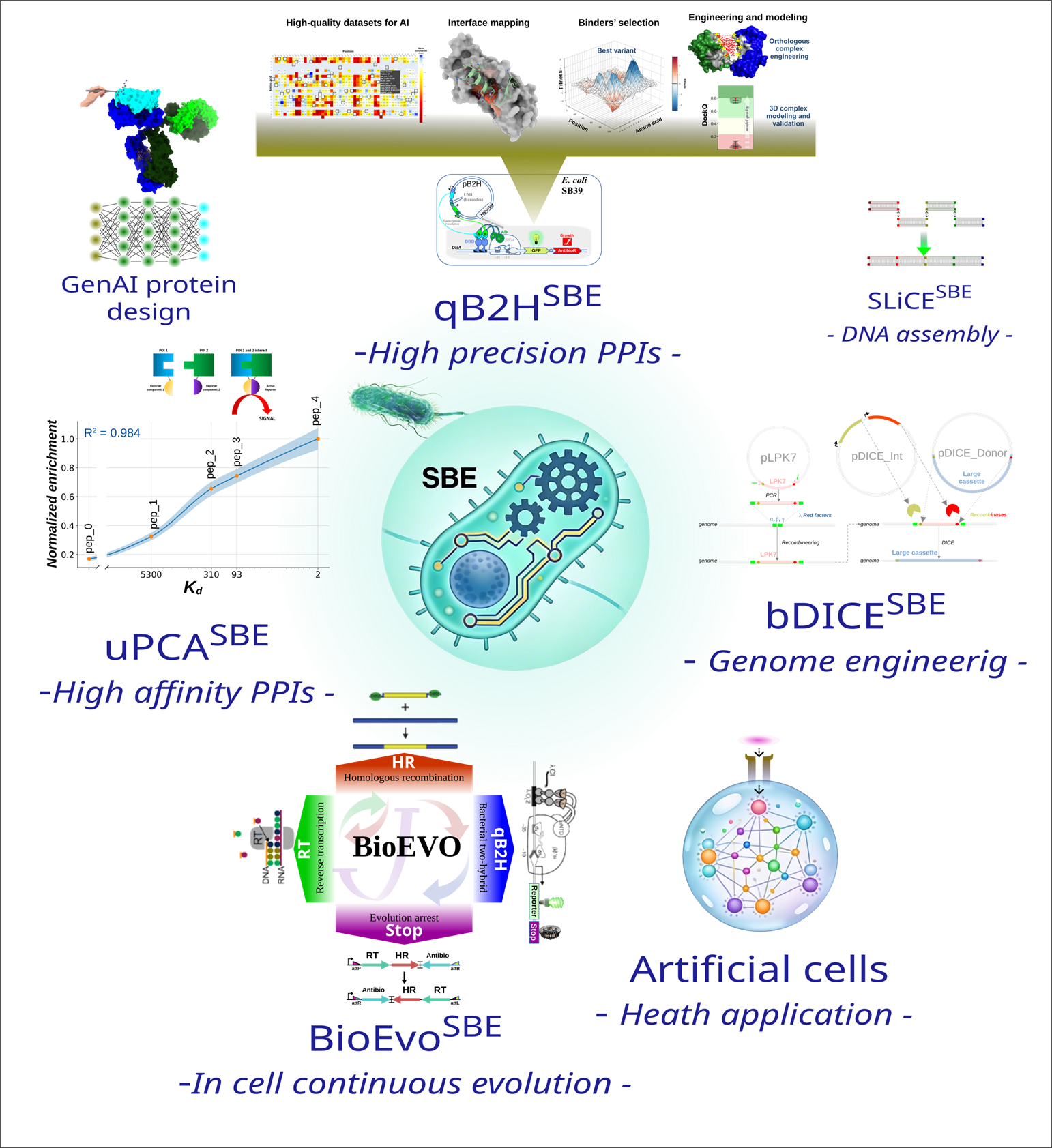
 

In parallel, our generative AI pipelines model antigen–antibody complexes at high resolution based on experimental data and design de novo proteins.We also work on:

  • Programmable artificial cells dedicated to healthcare applications.
  • uPCASBE: a universal protein complementation assay adaptable to diverse biological systems and offering a broad dynamic range.
  • BioEvoSBE: a continuous molecular evolution system.


These research axes form a synergistic technological ecosystem, opening new perspectives in bioproduction, immunotherapy, and synthetic biology. At the interface between wet lab and dry lab, our tools democratize biological engineering through integrated solutions tailored to different scales.

Immunogenicity of proteins and antibodies


Team leader

Bernard Maillere

+33 1 69 08 94 47

bernard.maillere@cea.fr


immunogenicite.png


Protein immunogenicity results in the production, in treated patients, of antibodies directed against the protein (anti-drug antibodies: ADA).


Therapeutic antibodies and proteins offer many advantages, such as high selectivity and low toxicity, but they also present the drawback of being potentially immunogenic, meaning that they can trigger an immune response against themselves. The antibodies produced by patients and directed against a therapeutic protein may decrease or increase the pharmacokinetics of the protein, neutralize its therapeutic activity, or induce allergic or autoimmune symptoms.


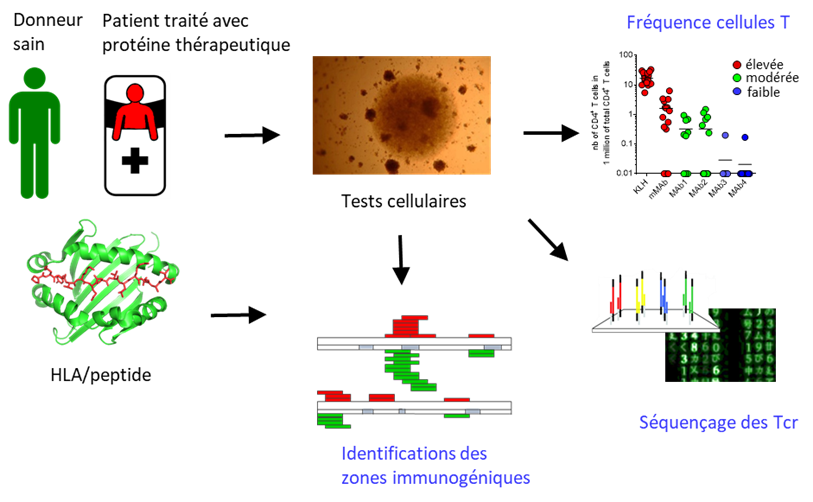
Given the central role of CD4 T lymphocytes in initiating and regulating immune responses, assessing CD4 T-cell responses specific to therapeutic molecules enables us to better understand the origin of therapeutic protein immunogenicity. Our studies focus on identifying the sequences recognized by these cells (T-cell epitopes), characterizing the clonality of T cell repertoires specific to therapeutic proteins, defining the effector or regulatory phenotype of CD4 T cells specific to therapeutic proteins, and developing strategies to generate de-immunized molecules, i.e., molecules that no longer induce immune responses.


We also develop novel T-cell characterization tools based on T-cell receptor (TCR) cloning.

 TCR.png


publications​

1.      Kot, O., L. Lequesne, H. W. Mages, S. Dubois, P. Piquet, F. Becher, B. Maillere, B. G. Dorner, S. Simon, D. Stern, and H. Nozach. 2025. Combining deep mutational scanning and SPR binning approaches for large-scale epitope identification of anti-ricin antibodies. mAbs 17: 2544922.
2.      Giraudet, R., A. Laroche, B. Chalopin, S. Dubois, E. Correia, I. Staropoli, O. Schwartz, B. Maillere, and H. Nozach. 2025. Immunogenicity of single-chain antibodies: germlining of a VHH lowers T-cell activation from epitopes in FR2 and CDR regions. mAbs 17: 2571406.
3.      Chevaleyre, C., L. Zimmermann, S. Specklin, D. Kereselidze, A. Bouleau, S. Dubois, H. Quelquejay, B. Maillere, N. Tournier, H. Nozach, and C. Truillet. 2025. PET Imaging of PD-L1 Occupancy for Preclinical Assessment of the Efficacy of Combined Anti-PD-L1 Immunotherapy and Targeted Therapy. J Nucl Med.
4.      Porcheddu, V., G. Lhomme, R. Giraudet, E. Correia, and B. Maillere. 2024. The self-reactive FVIII T cell repertoire in healthy individuals relies on a short set of epitopes and public clonotypes. Frontiers in immunology 15: 1345195.
5.      Stanajic-Petrovic, G., M. Keck, P. Barbe, A. Urman, E. Correia, P. Isnard, J. P. Duong Van Huyen, K. Chmeis, S. S. Diarra, S. Palea, F. Theodoro, A. L. Nguyen, F. Castelli, A. Pruvost, W. Zhao, C. Mendre, B. Mouillac, F. Bienaime, P. Robin, P. Kessler, C. Llorens-Cortes, D. Servent, H. Nozach, B. Maillere, D. Guo, C. Truillet, and N. Gilles. 2025. A Snake Toxin Derivative for Treatment of Hyponatremia and Polycystic Kidney Diseases. Journal of the American Society of Nephrology : JASN 36: 181-192.
6.      Miranda, M., B. E. Hansen, B. Wehbi, V. Porcheddu, F. P. J. Van Alphen, P. Kaijen, K. Fijnvandraat, S. Lacroix-Desmazes, M. Van den Biggelaar, B. Maillere, J. Voorberg, and E. Consortium. 2025. FVIII peptides presented on HLA-DP and identification of an A3 domain peptide binding with high affinity to the commonly expressed HLA-DP4. Haematologica 110: 1316-1327.
7.      Mallart, S., R. Ingenito, P. Magotti, A. Bresciani, A. Di Marco, S. Esposito, E. Monteagudo, F. Caretti, L. Orsatti, A. Santoprete, D. Roversi, F. Tucci, M. Veneziano, D. Brasseur, X. Chenede, A. Corbier, L. Gauzy-Lazo, V. Gervat, F. Marguet, C. Minoletti, O. Pasquier, B. Poirier, A. Azam, B. Maillere, E. Bianchi, P. Janiak, O. Duclos, and S. Illiano. 2025. Optimization of Single Relaxin B-Chain Peptide Leads to the Identification of R2R01, a Potent, Long-Acting RXFP1 Agonist for Cardiovascular and Renal Diseases. Journal of medicinal chemistry 68: 3873-3885.
8.      Lhomme, G., R. Giraudet, V. Porcheddu, E. Correia, R. Olaso, S. Hua, and B. Maillere. 2025. Deep exploration of the TCR CDR3beta repertoire specific for viral CD4 T-cell epitopes inside the circulating T-cell repertoire. Frontiers in immunology 16: 1713225.
9.      Poirier, B., O. Pasquier, X. Chenede, A. Corbier, P. Prigent, A. Azam, C. Bernard, M. Guillotel, F. Gillot, L. Riva, V. Briand, R. Ingenito, L. Gauzy-Lazo, O. Duclos, C. Philippo, B. Maillere, E. Bianchi, S. Mallart, P. Janiak, and S. Illiano. 2024. R2R01: A long-acting single-chain peptide agonist of RXFP1 for renal and cardiovascular diseases. British journal of pharmacology.
10.    Nabhan, M., S. Meunier, V. Le-Minh, B. Robin, M. de Bourayne, C. Smadja, B. Maillere, M. Pallardy, and I. Turbica. 2024. Infliximab aggregates produced in severe and mild elevated temperature stress conditions induce an extended specific CD4 T-cell response. European journal of pharmaceutical sciences : official journal of the European Federation for Pharmaceutical Sciences 192: 106670.
11.    Miranda, M., B. E. Hansen, B. Wehbi, V. Porcheddu, F. P. J. Van Alphen, P. Kaijen, K. Fijnvandraat, S. Lacroix-Desmazes, M. Van den Biggelaar, B. Maillere, J. Voorberg, and E. Consortium. 2024. FVIII peptides presented on HLA-DP and identification of an A3 domain peptide binding with high affinity to the commonly expressed HLA-DP4. Haematologica.
12.    Mikaeeli, S., A. Ben Djoudi Ouadda, A. Evagelidis, R. Essalmani, O. H. P. Ramos, C. Fruchart-Gaillard, and N. G. Seidah. 2024. Insights into PCSK9-LDLR Regulation and Trafficking via the Differential Functions of MHC-I Proteins HFE and HLA-C. Cells 13.
13.    Menier, C., S. Meunier, V. Porcheddu, L. Romano, E. Correia, F. Busato, J. Tost, and B. Maillere. 2024. Frequency of natural regulatory T cells specific for factor VIII in the peripheral blood of healthy donors. Eur J Immunol: e2350506.
14.    Malgorn, C., F. Becher, P. Bruyat, C. Fruchart-Gaillard, F. Beau, S. Bregant, and L. Devel. 2024. A New Affinity-Based Probe to Profile MMP Active Forms. Methods Mol Biol 2747: 29-39.
15.    Voorberg, J., T. Arfman, and B. Maillere. 2023. Big in Japan: HLA-DRB1 *08:03 and immune thrombotic thrombocytopenic purpura. J Thromb Haemost 21: 456-459.
16.    Vadon-Le Goff, S., A. Tessier, M. Napoli, C. Dieryckx, J. Bauer, M. Dussoyer, P. Lagoutte, C. Peyronnel, L. Essayan, S. Kleiser, N. Tueni, E. Bettler, N. Mariano, E. Errazuriz-Cerda, C. Fruchart Gaillard, F. Ruggiero, C. Becker-Pauly, J. M. Allain, L. Bruckner-Tuderman, A. Nystrom, and C. Moali. 2023. Identification of PCPE-2 as the endogenous specific inhibitor of human BMP-1/tolloid-like proteinases. Nature communications 14: 8020.
17.    Sivelle, C., R. Sierocki, Y. Lesparre, A. Lomet, W. Quintilio, S. Dubois, E. Correia, A. M. Moro, B. Maillere, and H. Nozach. 2023. Combining deep mutational scanning to heatmap of HLA class II binding of immunogenic sequences to preserve functionality and mitigate predicted immunogenicity. Frontiers in immunology 14: 1197919.
18.    Richard, M., S. Martin Aubert, C. Denis, S. Dubois, H. Nozach, C. Truillet, and B. Kuhnast. 2023. Fluorine-18 and Radiometal Labeling of Biomolecules via Disulfide Rebridging. Bioconjugate chemistry 34: 2123-2132.
19.    Pruvost, T., M. Mathieu, S. Dubois, B. Maillere, E. Vigne, and H. Nozach. 2023. Deciphering cross-species reactivity of LAMP-1 antibodies using deep mutational epitope mapping and AlphaFold. mAbs 15: 2175311.
20.    Fruchart Gaillard, C., A. B. D. Ouadda, L. Ciccone, E. Girard, S. Mikaeeli, A. Evagelidis, M. Le Devehat, D. Susan-Resiga, E. C. Lajeunesse, H. Nozach, O. H. P. Ramos, A. Thureau, P. Legrand, A. Prat, V. Dive, and N. G. Seidah. 2023. Molecular interactions of PCSK9 with an inhibitory nanobody, CAP1 and HLA-C: Functional regulation of LDLR levels. Molecular metabolism 67: 101662.
21.    Essalmani, R., U. Andreo, A. Evagelidis, M. Le Devehat, O. H. Pereira Ramos, C. Fruchart Gaillard, D. Susan-Resiga, E. A. Cohen, and N. G. Seidah. 2023. SKI-1/S1P Facilitates SARS-CoV-2 Spike Induced Cell-to-Cell Fusion via Activation of SREBP-2 and Metalloproteases, Whereas PCSK9 Enhances the Degradation of ACE2. Viruses 15.
22.    Ciccone, L., C. Camodeca, N. Tonali, L. Barlettani, A. Rossello, C. Fruchart Gaillard, J. Kaffy, G. Petrarolo, C. La Motta, S. Nencetti, and E. Orlandini. 2023. New Hybrid Compounds Incorporating Natural Products as Multifunctional Agents against Alzheimer's Disease. Pharmaceutics 15.
23.    Chevaleyre, C., A. Novell, N. Tournier, A. Dauba, S. Dubois, D. Kereselidze, E. Selingue, B. Jego, B. Maillere, B. Larrat, H. Nozach, and C. Truillet. 2023. Efficient PD-L1 imaging of murine glioblastoma with FUS-aided immunoPET by leveraging FcRn-antibody interaction. Theranostics 13: 5584-5596.
24.    Antunes, A., L. Alvarez-Vallina, F. Bertoglio, N. Bouquin, S. Cornen, F. Duffieux, P. Ferre, R. Gillet, C. Jorgensen, M. B. Leick, B. Maillere, H. Negre, M. Pelegrin, N. Poirier, D. Reusch, B. Robert, G. Serre, A. Vicari, M. Villalba, C. Volpers, G. Vuddamalay, H. Watier, T. Wurch, L. Zabeau, S. Zielonka, B. Zhang, A. Beck, and P. Martineau. 2023. 10th antibody industrial symposium: new developments in antibody and adoptive cell therapies. mAbs 15: 2211692.
25.    Tran, V. L., A. Bouleau, H. Nozach, M. Richard, C. Chevaleyre, S. Dubois, D. Kereselidze, B. Kuhnast, M. J. Evans, S. Specklin, and C. Truillet. 2022. Impact of Radiolabeling Strategies on the Pharmacokinetics and Distribution of an Anti-PD-L1 PET Ligand. Molecular pharmaceutics.
26.    Schneider, F. S., L. Molina, M. C. Picot, N. L'Helgoualch, J. Espeut, P. Champigneux, M. Alali, J. Baptiste, L. Cardeur, C. Carniel, M. Davy, D. Dedisse, B. Dubuc, H. Fenech, V. Foulongne, C. F. Gaillard, F. Galtier, A. Makinson, G. Marin, R. M. Santos, D. Morquin, A. Ouedraogo, A. P. Lejeune, M. Quenot, P. Keiflin, F. C. Robles, C. R. Rego, N. Salvetat, C. Trento, D. Vetter, F. Molina, and J. Reynes. 2022. Performances of rapid and connected salivary RT-LAMP diagnostic test for SARS-CoV-2 infection in ambulatory screening. Scientific reports 12: 2843.
27.    Laroche, A., M. L. Orsini Delgado, B. Chalopin, P. Cuniasse, S. Dubois, R. Sierocki, F. Gallais, S. Debroas, L. Bellanger, S. Simon, B. Maillere, and H. Nozach. 2022. Deep mutational engineering of broadly-neutralizing nanobodies accommodating SARS-CoV-1 and 2 antigenic drift. mAbs 14: 2076775.
28.    de Bourayne, M., S. Meunier, S. Bitoun, E. Correia, X. Mariette, H. Nozach, and B. Maillere. 2022. Pegylation Reduces the Uptake of Certolizumab Pegol by Dendritic Cells and Epitope Presentation to T-Cells. Frontiers in immunology 13: 808606.
29.    Ciccone, L., G. Petrarolo, F. Barsuglia, C. Fruchart-Gaillard, E. Cassar Lajeunesse, A. T. Adewumi, M. E. S. Soliman, C. La Motta, E. Orlandini, and S. Nencetti. 2022. Nature-Inspired O-Benzyl Oxime-Based Derivatives as New Dual-Acting Agents Targeting Aldose Reductase and Oxidative Stress. Biomolecules 12.
30.    Cahuzac, H., A. Sallustrau, C. Malgorn, F. Beau, P. Barbe, V. Babin, S. Dubois, A. Palazzolo, R. Thai, I. Correia, K. B. Lee, S. Garcia-Argote, O. Lequin, M. Keck, H. Nozach, S. Feuillastre, X. Ge, G. Pieters, D. Audisio, and L. Devel. 2022. Monitoring In Vivo Performances of Protein-Drug Conjugates Using Site-Selective Dual Radiolabeling and Ex Vivo Digital Imaging. Journal of medicinal chemistry 65: 6953-6968.
31.    Bouleau, A., H. Nozach, S. Dubois, D. Kereselidze, C. Chevaleyre, C. I. Wang, M. J. Evans, V. Lebon, B. Maillere, and C. Truillet. 2022. Optimizing Immuno-PET Imaging of Tumor PD-L1 Expression: Pharmacokinetic, Biodistribution, and Dosimetric Comparisons of (89)Zr-Labeled Anti-PD-L1 Antibody Formats. J Nucl Med 63: 1259-1265.
32.    Ascough, S., R. J. Ingram, K. K. Y. Chu, S. J. Moore, T. Gallagher, H. Dyson, M. Doganay, G. Metan, Y. Ozkul, L. Baillie, E. D. Williamson, J. H. Robinson, B. Maillere, R. J. Boyton, and D. M. Altmann. 2022. Impact of HLA Polymorphism on the Immune Response to Bacillus Anthracis Protective Antigen in Vaccination versus Natural Infection. Vaccines 10.
33.    Sierocki, R., B. Jneid, M. L. Orsini Delgado, M. Plaisance, B. Maillere, H. Nozach, and S. Simon. 2021. An antibody targeting type III secretion system induces broad protection against Salmonella and Shigella infections. PLoS neglected tropical diseases 15: e0009231.
34.    Kaminska, M., P. Bruyat, C. Malgorn, M. Doladilhe, E. Cassar-Lajeunesse, C. Fruchart Gaillard, M. De Souza, F. Beau, R. Thai, I. Correia, A. Galat, D. Georgiadis, O. Lequin, V. Dive, S. Bregant, and L. Devel. 2021. Ligand-Directed Modification of Active Matrix Metalloproteases: Activity-based Probes with no Photolabile Group. Angew Chem Int Ed Engl 60: 18272-18279.
35.    Gallais, Y., R. Sierocki, G. Lhomme, C. Sivelle, D. Kiseljak, F. Wurm, S. Djoulah, A. Bouzidi, J. Kerzerho, and B. Maillere. 2021. Large-scale mapping of the Ebola NP and GP proteins reveals multiple immunoprevalent and conserved CD4 T-cell epitopes. Cellular & molecular immunology 18: 1323-1325.
36.    Bouleau, A., H. Nozach, S. Dubois, D. Kereselidze, C. Chevaleyre, C. I. Wang, M. J. Evans, V. Lebon, B. Maillere, and C. c. Truillet. 2021. Optimizing immunoPET imaging of tumor PD-L1 expression: pharmacokinetics, biodistribution and dosimetric comparisons of (89)Zr-labeled anti-PD-L1 antibody formats. J Nucl Med.
37.    Azam, A., S. Mallart, S. Illiano, O. Duclos, C. Prades, and B. Maillere. 2021. Introduction of Non-natural Amino Acids Into T-Cell Epitopes to Mitigate Peptide-Specific T-Cell Responses. Frontiers in immunology 12: 637963.