Marine phytoplankton plays a fundamental role in global biogeochemical cycles and in the primary production of the oceans. These microscopic organisms are exposed to daily and seasonal variations in light that strongly depend on latitude. In terrestrial plants, adaptation to these cycles relies on well-characterized mechanisms of photoperiodism and circadian rhythms. In contrast, how marine picoalgae perceive and integrate these light signals has remained largely unexplored.
In this study, the authors focused on several species of green picoalgae of the order Mamiellales (Ostreococcus, Bathycoccus, and Micromonas), which are broadly distributed across the world’s oceans. Comparative genome analyses show that these species share a common set of genes involved in the circadian clock and light perception, suggesting the existence of a molecular core that emerged early in their evolution. However, this shared core is modulated by numerous events of gene duplication, loss or rearrangement, which differ between lineages.
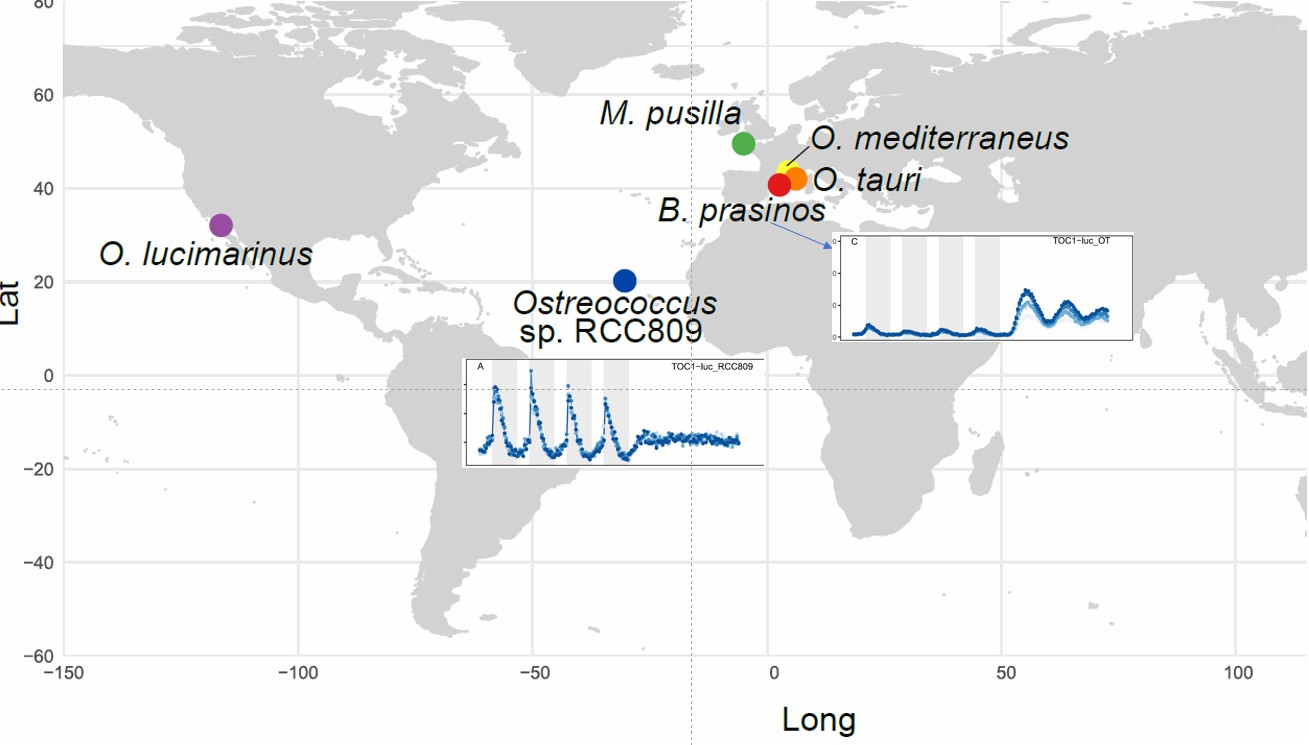
Phylogenetic analyses highlight a strong diversification of photoreceptors, particularly in the genus Micromonas, as well as extensive variability in CCT-domain proteins, a key family involved in circadian regulation and photoperiodism in plants. A striking result concerns the TOC1 protein, a central component of the circadian clock in Ostreococcus tauri. The authors show that TOC1 is either absent or highly truncated in certain tropical species, notably Ostreococcus sp. RCC809.
To evaluate the functional consequences of this divergence, experimental approaches based on luciferase reporter lines were implemented. They reveal that in the tropical strain Ostreococcus sp. RCC809, the TOC1/CCA1 circadian oscillator is no longer functional, unlike in species from temperate latitudes. These observations suggest that some core circadian mechanisms may become dispensable in environments where day length varies little throughout the year.
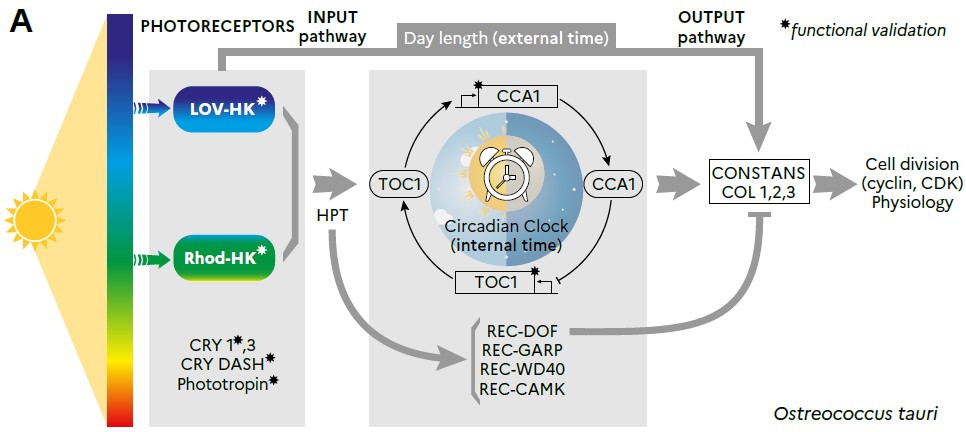
The exploitation of metagenomic and metatranscriptomic data from the Tara Oceans expeditions confirms that species distribution and expression of their circadian genes are closely linked to environmental conditions. The authors thus propose that picoalgae from high latitudes, exposed to strong seasonal variations in photoperiod, retain robust circadian clocks, whereas those from tropical regions may partially dispense with them.
@J. Rigonato / CEA
This study highlights the remarkable plasticity of time-keeping mechanisms in marine picoalgae and provides an evolutionary framework for understanding how these organisms adapt to light gradients on a global scale.
Contact: Olivier Jaillon ; Janaina Rigonat