Skin substitutes with established clinical applications
Skin holds a unique place in the history of regenerative medicine. As early as the 1980s, the ex vivo culture of patient-derived keratinocytes made it possible to produce epidermal sheets capable of providing durable coverage of very large areas in severely burned patients. More recently, combining this technology with gene therapy has enabled the reconstruction of genetically corrected epidermis in patients with junctional epidermolysis bullosa, a severe genetic skin disorder.
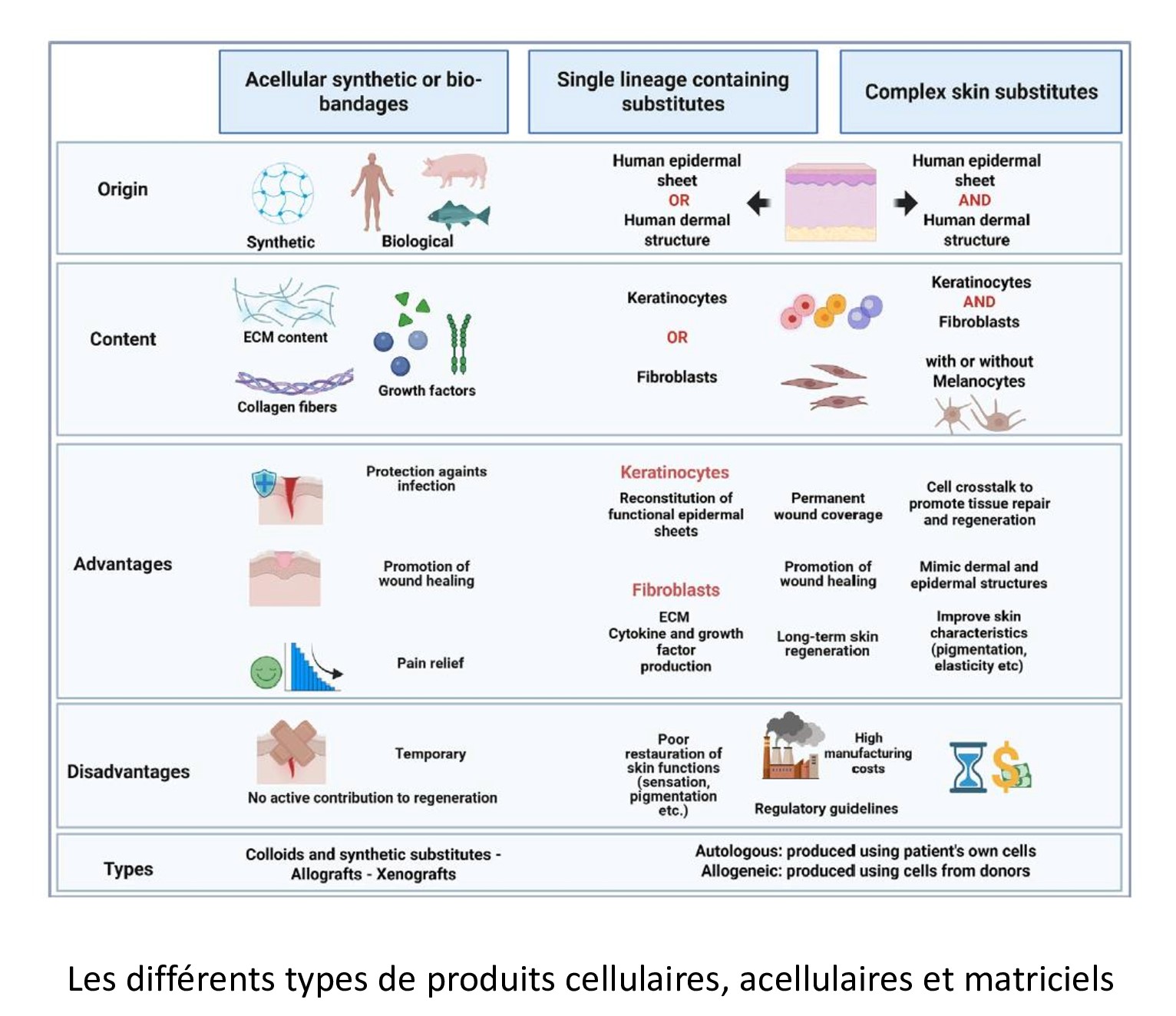
These successes have paved the way for a wide range of skin substitutes, from acellular matrices to products containing one or more cell populations. The authors distinguish, in particular, substitutes containing keratinocytes or fibroblasts alone from more complex constructs combining several cell lineages within dermal-epidermal structures. Their indications now extend beyond severe burns to chronic wounds and ulcers, whose prevalence is increasing, notably as a result of population ageing and metabolic diseases.
However, there is no universal skin substitute. Requirements vary considerably depending on whether the objective is to provide temporary wound protection, stimulate healing, or achieve long-term reconstruction of functional skin.
Autologous or allogeneic cells: two complementary strategies
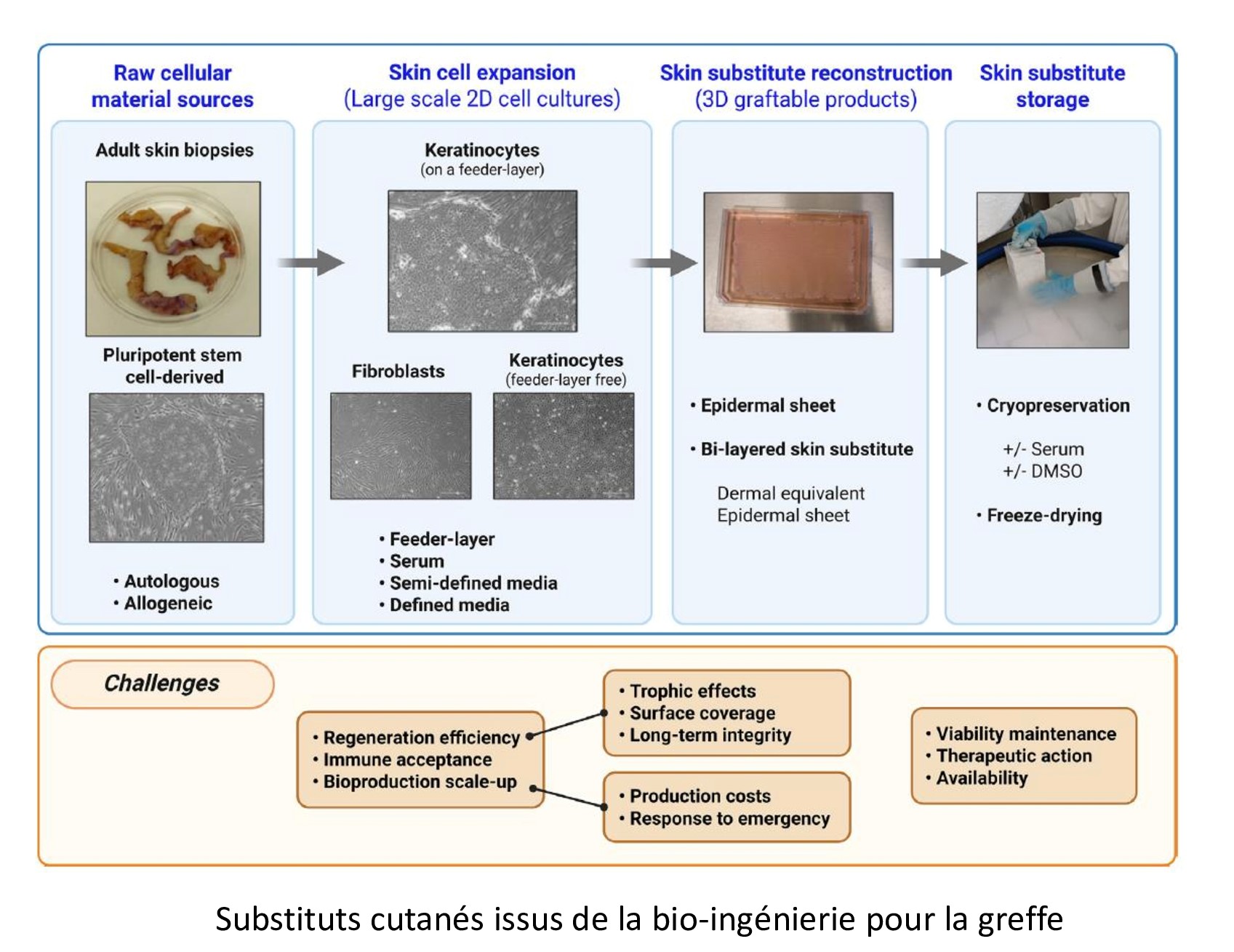
For permanent skin reconstruction, cells taken from the patient, or autologous cells, remain a preferred option. Their main advantage is the absence of immune rejection. Following the collection of a small skin biopsy, keratinocytes can be expanded in culture and then assembled into epidermal sheets or substitutes also containing fibroblasts.
However, this personalized approach involves several constraints: the time required for cell expansion, production costs, the logistics associated with biological products with a limited shelf life, and particularly stringent regulatory requirements. These factors still restrict their use to certain specialized clinical settings.
By contrast, allogeneic cells, obtained from donors, can be produced in large quantities, stored in cell banks, and made available more rapidly. They therefore offer attractive prospects for the production of “off-the-shelf” grafts and for treating large numbers of patients. Their main limitation, however, remains immune rejection when long-term engraftment is required.
The review discusses several research strategies aimed at producing less immunogenic cells, notably through genome editing or modulation of molecules involved in immune tolerance, such as HLA-G and PD-L1. These approaches nevertheless require careful evaluation, particularly with regard to safety.
Holoclones: a major requirement for long-term epidermal reconstruction
A central point of the review concerns the quality of the keratinocytes used to manufacture grafts.
Not all keratinocytes have the same regenerative capacity. Among them, cells capable of forming holoclones display the highest proliferative potential and correspond to the keratinocyte stem cell population. They can be expanded over many generations while retaining their ability to regenerate an epidermis.
Long-term grafting studies show that although different progenitor cell populations initially contribute to skin reconstruction, the contribution of holoclone-derived cells gradually becomes predominant. These cells therefore ensure the long-term maintenance of the epidermis after grafting.
Preserving these keratinocytes with high clonogenic potential throughout the manufacturing process is therefore one of the major biological requirements for developing substitutes intended for permanent reconstruction. This issue is at the core of several research projects carried out by LR2C teams.
Moving away from animal-derived components
The need to preserve epidermal stem cells nevertheless raises one of the field’s major current challenges.
Historically, keratinocyte expansion has relied on culture media containing serum and on feeder layers of fibroblasts, often murine 3T3 cells. These methods have demonstrated their clinical effectiveness and have been used to treat thousands of patients. However, they rely on biological components whose composition can be poorly defined and, in some cases, of animal origin.
Such products can generate batch-to-batch variability, increase risks associated with the potential presence of infectious agents, and make manufacturing processes more difficult to standardize. Their use is also becoming increasingly difficult to reconcile with regulatory expectations for the manufacture of advanced therapy medicinal products.
One of the main objectives is therefore to develop culture systems that are serum-free, xeno-free and, ideally, chemically defined.
Several culture media that partially meet these criteria are already available or under development. However, striking the right balance remains difficult: undefined components must be eliminated while preserving the expansion capacity of the most immature keratinocytes and their long-term regenerative potential.
It is precisely this tension between regulatory requirements and biological performance that the authors identify as one of the main challenges to be overcome in developing next-generation skin substitutes.
Toward reconstructed skin that more closely resembles native skin
Skin substitutes composed only of keratinocytes and fibroblasts reproduce only part of the complexity of natural skin.
Research efforts are therefore seeking to incorporate additional cell populations. Adding melanocytes could help restore functional pigmentation, while integrating endothelial cells aims to accelerate graft vascularization, a crucial step for graft survival after transplantation.
Mesenchymal stromal cells are also being studied for their immunomodulatory, angiogenic and regenerative properties. They could help promote vascularization, re-epithelialization and extracellular matrix remodeling.
Reconstructing skin appendages — including hair follicles, sebaceous glands and sweat glands — remains a major challenge. Despite several experimental advances, no currently available substitute can yet restore the full range of functions and structures found in native skin.
3D bioprinting as a route toward the grafts of the future
3D bioprinting represents another promising approach. It enables the controlled deposition of multiple cell types and biomaterials in order to recreate a tissue architecture that more closely resembles that of skin.
Vascularized dermal-epidermal grafts containing keratinocytes, fibroblasts, endothelial cells and pericytes have already been produced experimentally under animal-product-free conditions and tested in preclinical models.
In the longer term, direct bioprinting onto the wound could make it possible to deposit cells and biomaterials directly at the treatment site, adapting their distribution to the geometry of the lesion. However, results remain largely preclinical and many obstacles still need to be overcome, including cell viability, rapid vascularization, sterility, reproducibility, automation, device regulation and integration into surgical practice.
From proof of concept to large-scale production
According to the authors, future progress will therefore depend not only on the ability to construct increasingly complex skin. Successful clinical translation will also require the capacity to standardize and industrialize production while preserving the cells’ essential biological properties.
In the short term, the priority is to establish defined culture conditions capable of preserving keratinocyte stem cells. In the medium term, the development of well-characterized allogeneic cell banks could facilitate large-scale production and improve access to rapidly available grafts. In the longer term, automation, 3D bioprinting and the reconstruction of the various skin appendages could lead to substitutes that reproduce the structure and functions of native skin far more completely.
This review therefore highlights the need for a deeply translational approach, combining stem cell biology, tissue engineering, biomanufacturing and regulatory requirements in order to transform laboratory advances into therapeutic products that are genuinely accessible to patients.
Contact : Nicolas Fortunel