Lamin B1: beyond its structural role
Separase plays a central role at the onset of anaphase: it cleaves cohesin, the protein complex that holds sister chromatids together, thereby allowing them to segregate toward the two daughter cells. Its activity must therefore be tightly controlled. Premature or insufficient activation can lead to chromosome segregation errors, abnormal chromosome numbers, and genomic instability.
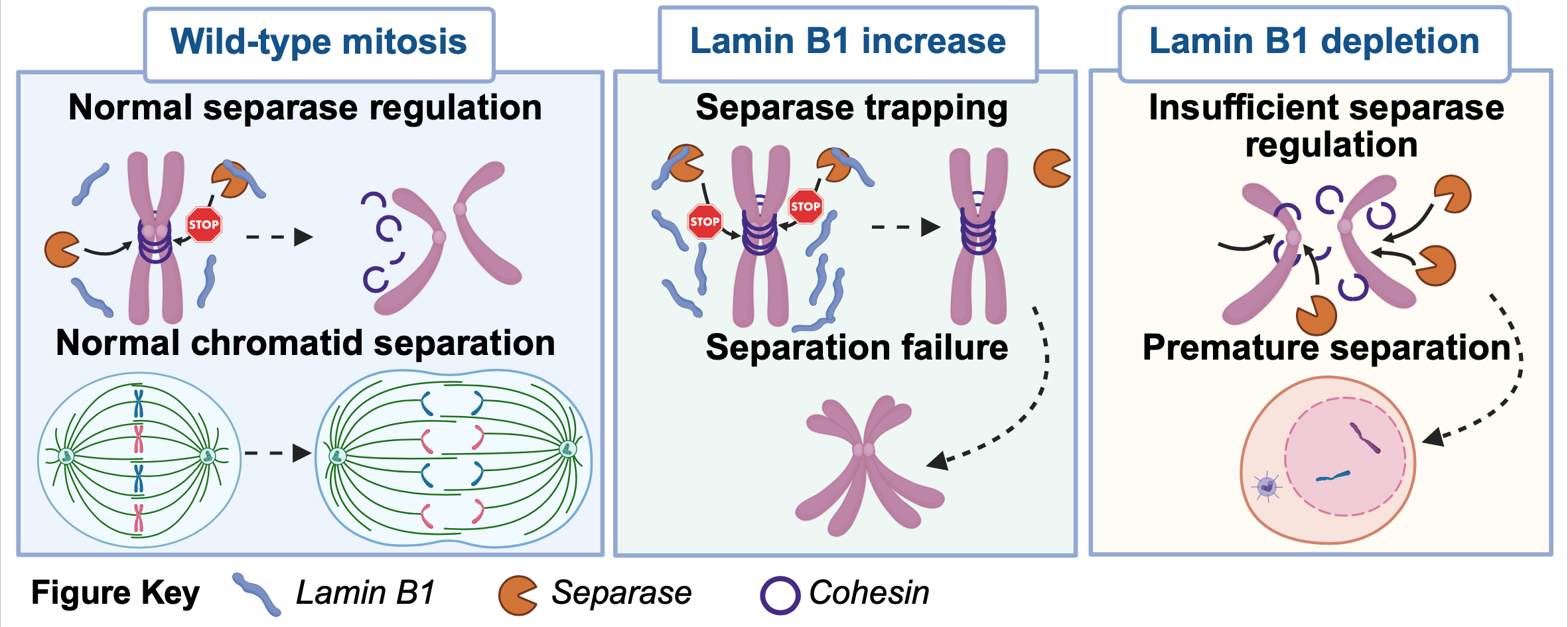
Lamin B1, a structural component of the nuclear envelope, is best known for its role in maintaining nuclear organization and integrity. The authors show that it also plays a direct role during mitosis. When lamin B1 expression is increased, cells display defects in chromatid separation as well as centrosome amplification. Conversely, reduced lamin B1 levels promote premature sister chromatid separation.
An interaction with separase
The researchers show that lamin B1 and separase interact in human cells, with particularly strong association at the beginning of mitosis, especially during prophase.
This interaction directly influences the localization of separase on chromosomes. Reduced lamin B1 levels increase separase recruitment to mitotic chromatin, whereas lamin B1 overexpression has the opposite effect.
The model proposed in the graphical abstract clearly illustrates this mechanism: normal lamin B1 levels allow proper regulation of separase; excess lamin B1 tends to retain separase and delay its activity, whereas lamin B1 deficiency results in insufficient control and premature chromatid separation.
A new player in mitotic control
Using a fluorescent reporter system that enables real-time visualization of separase activity, the researchers show that excess lamin B1 delays separase activation and entry into anaphase. It also leads to an increased number of misaligned chromosomes.
Furthermore, artificially increasing separase levels largely corrects the centrosome amplification caused by lamin B1 overexpression. This finding strengthens the hypothesis that the observed defects are indeed due to disruption of separase function.
The study therefore reveals an additional level of regulation in chromosome segregation, directly linking a component of the nuclear envelope to the control of separase. As lamin B1 is dysregulated in several cancers, these findings also provide new insight into the mechanisms through which its alteration may contribute to genomic instability and tumorigenesis.
Contacts : Gaëlle Pennarun et Pascale Bertrand