Telomeres, located at the ends of chromosomes, play an essential role in genome stability. They must be protected so that they are not mistaken for DNA double-strand breaks, which would trigger inappropriate repair mechanisms. When telomeres become too short, this protection weakens: chromosome ends can then activate the DNA damage response, be degraded, or fuse with one another.
At the heart of these processes is the MRX complex, a major player in the detection and repair of double-strand breaks. This complex is essential for DNA repair, but its activity must be strictly controlled at telomeres to prevent harmful chromosomal rearrangements.
In this study, the researchers focused on the role of Rap1, a protein that binds in arrays along telomeric DNA in the yeast Saccharomyces cerevisiae. By combining genetic approaches with in vitro reconstituted biochemistry, they show that Rap1 protects chromosome ends by physically preventing MRX from accessing the DNA.
This mechanism relies on a steric hindrance effect: the longer and denser the DNA segment covered by Rap1, the more effectively MRX is prevented from recognizing the DNA end. The authors showed that a sufficient number of Rap1 molecules, corresponding to approximately 150 base pairs of covered DNA, is required to ensure effective protection.
This protection does not depend on a direct interaction between Rap1 and MRX, but rather on the physical coating of the DNA. When Rap1 binding sites are too widely spaced, or too far from the chromosome end, MRX can once again access the DNA and trigger inappropriate repair activities.
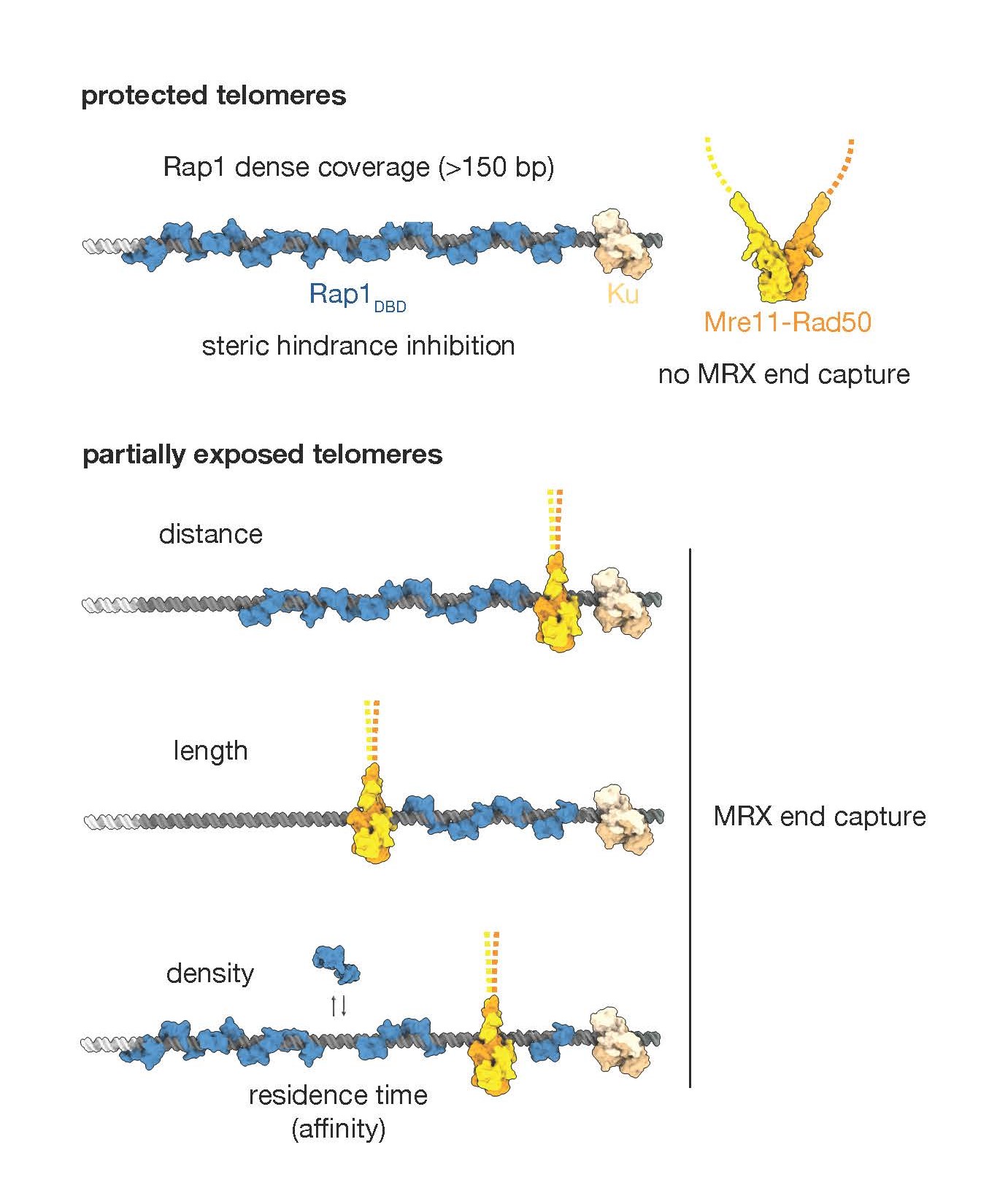
@S. Marcand, CEA
These results provide a better understanding of how cells detect telomeres that have become too short. When Rap1 coverage decreases, MRX can recognize the chromosome end, contributing to the activation of cellular responses linked to telomere shortening. This mechanism may therefore contribute to telomere length homeostasis and, more broadly, to senescence processes associated with short telomeres.
Beyond yeast, this work offers fundamental insight into the principles governing chromosome-end protection. Similar mechanisms may exist in other organisms, where telomeres are also coated by specific proteins. It therefore opens new perspectives for better understanding the links between genome stability, cellular ageing and protection against chromosomal rearrangements.
Contact : Stéphane Marcand