The study forms part of the OBEPINE+ project. Selected and funded under the France 2030 plan, as part of the national acceleration strategy for emerging infectious diseases and CBRN threats, the project aims to build a research and development platform in wastewater epidemiology in order to develop an early-warning and infectious disease monitoring strategy. In this context, partners including CNRGH are developing new methods for detection, sampling, quantification, sequencing and modelling to monitor emerging infectious diseases and high-risk pathogens in wastewater.
Wastewater analysis has become a key tool for monitoring the circulation of viruses such as SARS-CoV-2 at population level. However, current methods are mainly based on the detection of viral RNA fragments, without providing information on their integrity. Yet this is an essential parameter for sequencing efficiency and for the correct interpretation of data, particularly in relation to the infectivity of viral particles present in environmental samples.
In this context, the authors developed an innovative long-fragment digital RT-PCR approach (LR-RT-dPCR) to assess viral RNA integrity across long regions of the genome. This method is based on reverse transcription covering long fragments, followed by multiplex amplification targeting different regions of the genome, thereby offering a more comprehensive view of the condition of viral RNA.
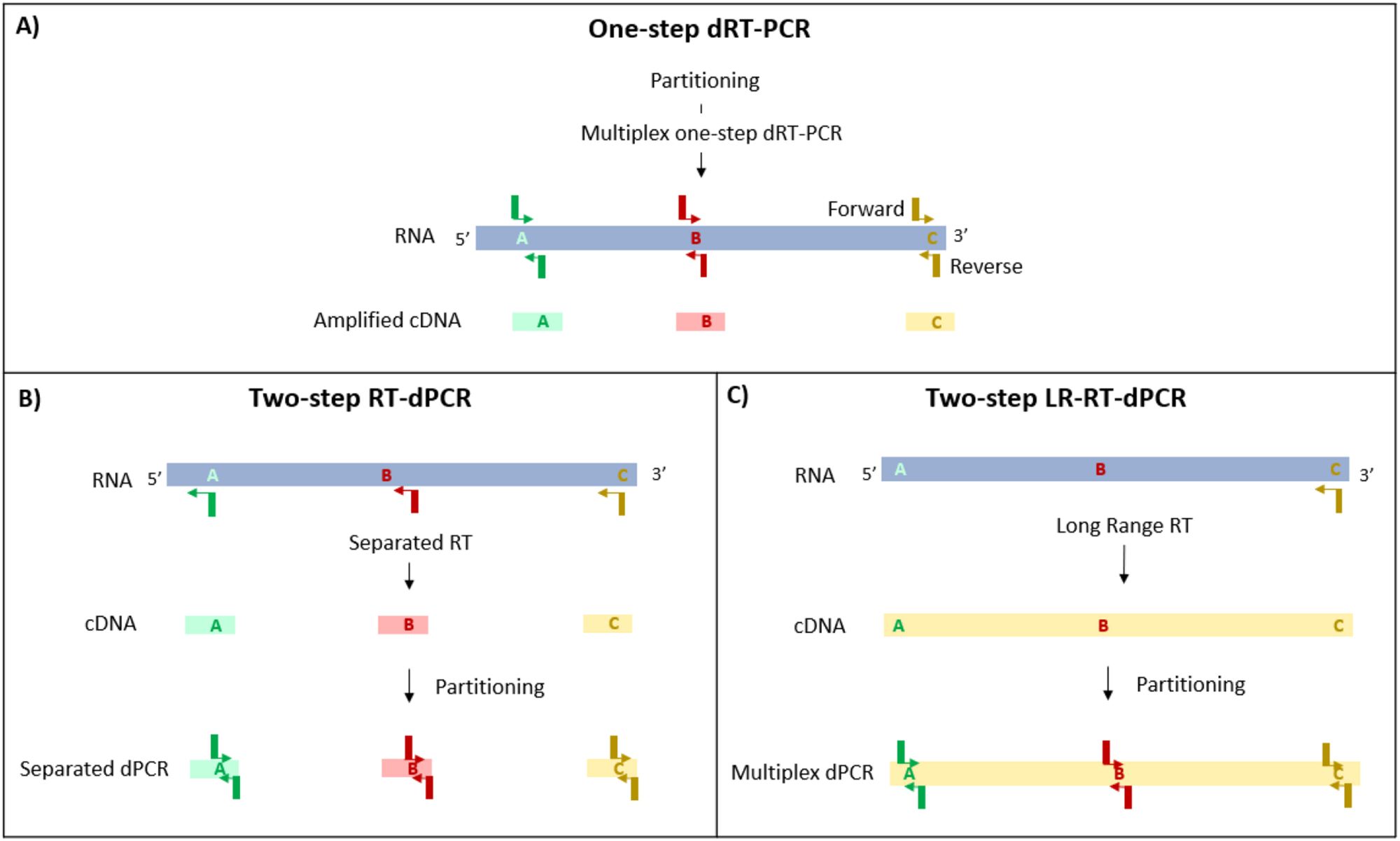
Three digital RT-PCR protocols targeting three different regions
@Authors / Elsevier
The method was validated using two models: SARS-CoV-2 and RNA bacteriophages (FRNAPH-I), both under controlled conditions and in wastewater samples in which these two species are naturally present. It showed greater sensitivity and more uniform detection of the different genomic regions compared with conventional approaches.
The results highlight a high level of viral RNA degradation in wastewater, with very low integrity for bacteriophages and variable integrity for SARS-CoV-2. They also show that RNA integrity does not depend solely on fragment length, but also on the intrinsic characteristics of the sequences, with some genomic regions being more stable than others.
This approach opens up new perspectives for improving environmental virus surveillance, refining the interpretation of sequencing data and gaining a better understanding of infectious risks in complex matrices.
Contact : Jean-François Deleuze