Gliomas, and glioblastomas in particular, are among the most aggressive brain tumours. Despite recent therapeutic advances, their management remains challenging because of their strong invasive capacity and resistance to treatment.
This review brings together the latest knowledge on the immune cells present in the tumour environment of gliomas: microglia, which play a major role in the maturation of the central nervous system and also have immune functions, and macrophages recruited from the bloodstream. These populations, collectively referred to as tumour-associated macrophages and microglia (TAMs), make up a significant part of the tumour microenvironment and directly influence disease progression.
Immune cells with multiple functions
The studies summarized in this review show that these cells can no longer be regarded as a homogeneous population. Their identity and functions vary according to their origin, their location within the tumour and the signals they receive from the microenvironment.
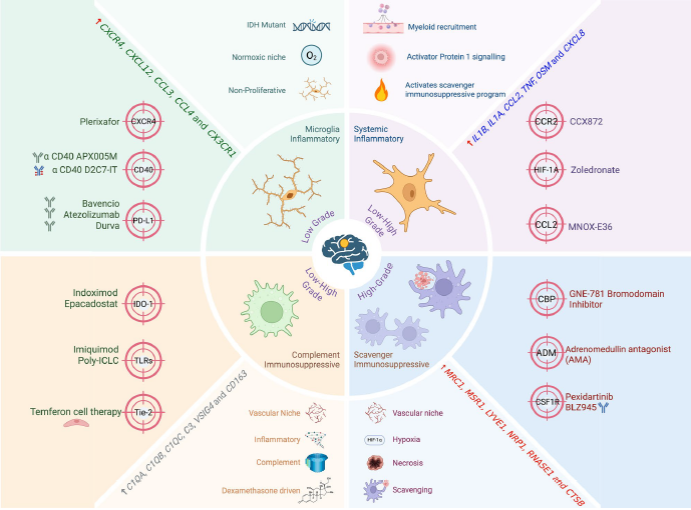
The authors emphasize in particular that tumour cells are able to hijack these immune mechanisms to their own advantage. Under the influence of the tumour, microglia and macrophages can adopt functions that promote tumour growth, invasion of neighbouring tissues, formation of new blood vessels and resistance to treatment.
Moving beyond simplified models
One of the key messages of this review is the need to reconsider the classic classification of macrophages into “M1” and “M2” states, which is now considered too simplistic to describe the diversity of populations observed in gliomas. Recent single-cell analyses instead reveal a wide range of functional states and a high degree of cellular plasticity.
The authors also call for more precise terminology to describe the immune phenomena observed in brain tumours, in order to accelerate research progress and facilitate the development of new therapeutic approaches.
Towards more targeted Immunotherapies
The knowledge gained in recent years opens up promising prospects. Researchers are now considering strategies designed to specifically target certain subpopulations of microglia and macrophages, or to modify their functions in order to restore an effective antitumour response. The consensus also highlights the therapeutic potential of extracellular vesicles, which are involved in communication between tumour cells and immune cells.
In the long term, this improved understanding of the tumour microenvironment could make it possible to transform an immunosuppressive environment that favours tumour growth into one capable of supporting an immune response against cancer. This paradigm shift could contribute to the development of more effective treatments for patients with glioblastoma and other forms of glioma.
Contact : Marc-André Mouthon