mRNA and viral vector vaccines have profoundly transformed the fight against the COVID-19 pandemic. However, the regular emergence of new variants capable of partially evading the immune response underscores the need to develop vaccination strategies that can induce broader and longer-lasting protection, including against potential emerging coronaviruses.
To address this challenge, the scientists behind the study developed an original vaccine platform based on the targeting of dendritic cells, which are specialized in initiating the immune response. Using an antibody directed against the CD40 receptor expressed on their surface, viral antigens are delivered directly to the cells responsible for activating B and T lymphocytes. This approach is designed to optimize the quality of the immune response while eliminating the need for adjuvants, which are generally required to enhance the effectiveness of protein-based vaccines.
The study compares two vaccine candidates based on this technology. The first, CD40.RBDv, presents two sequences from the receptor-binding domain (RBD) of the Spike protein, the main determinant of viral neutralization. The second, CD40.Pan.CoV, combines an RBD containing the principal mutations found in SARS-CoV-2 variants with a more conserved antigen derived from the nucleocapsid protein (NCAP). This design is intended to broaden the range of epitopes recognized by the immune system and strengthen protection against variants.
Both vaccines were evaluated in non-human primates, the reference model for the study of human infectious diseases. Teams from IDMIT Department conducted an in-depth characterization of the immune responses induced following vaccination, analyzing both neutralizing antibodies and cellular immune responses.
The results show that both candidates induce high levels of antibodies capable of effectively neutralizing several SARS-CoV-2 variants. This humoral response is accompanied by robust activation of CD4⁺ T cells, which are essential for the development of long-lasting immune memory, as well as cellular responses that contribute to the elimination of infected cells. Remarkably, these responses persist for several months after vaccination, indicating particularly stable immune memory.
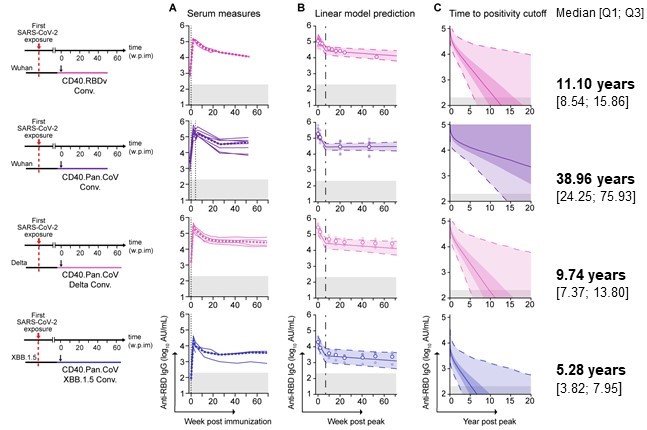
Durability and persistence of the antibody response induced by the CD40-targeted vaccine platform
The study also shows that these vaccine candidates can effectively boost immune responses in individuals who have previously been infected with or vaccinated against SARS-CoV-2—two particularly relevant scenarios given the immunity now present in the human population.
This work highlights the value of targeting dendritic cells as a next-generation vaccination strategy. By promoting optimal antigen presentation to the immune system, this approach generates a powerful and long-lasting response without the need for conventional adjuvants, while maintaining an excellent safety profile in the preclinical model.
The teams from IDMIT Department played a major role in the study by conducting the preclinical evaluation of both vaccine candidates in non-human primates. Their expertise in infection models and immune-response analysis made it possible to demonstrate the potential of this vaccine platform before its transition to clinical evaluation.
As these vaccine candidates are now being evaluated in humans, this study represents an important step towards the development of vaccines capable of providing long-lasting protection against both current and future coronaviruses. More broadly, the CD40 receptor-targeting platform could be adapted to other infectious diseases requiring a robust and sustained immune response.
Contact : Romain Marlin