Tara Polaris I: Genoscope sets out to explore the biodiversity of the Arctic Ocean
The central Arctic Ocean is one of the most extreme and least studied environments on our planet. It is also one of the regions where the effects of climate change are occurring most rapidly: warming there is three to four times faster than in the rest of the world. Understanding how this environment is changing and how the organisms living there are adapting is therefore a major scientific challenge.
This is precisely the aim of Tara Polaris, an unprecedented scientific programme led by the Tara Ocean Foundation. Over twenty years, through to 2046, ten successive two-year expeditions will continuously study the atmosphere, sea ice and underlying ocean, as well as the complex interactions between these different components.
To make such long-term observations possible, Tara Polar Station was specifically designed to drift with the sea ice. This 26-metre-long scientific station will remain trapped in the ice for around 90% of the time and is designed to withstand temperatures below -50°C. Researchers, engineers and sailors will therefore be able to observe the Arctic ecosystem throughout the year, including during the long months of polar night.
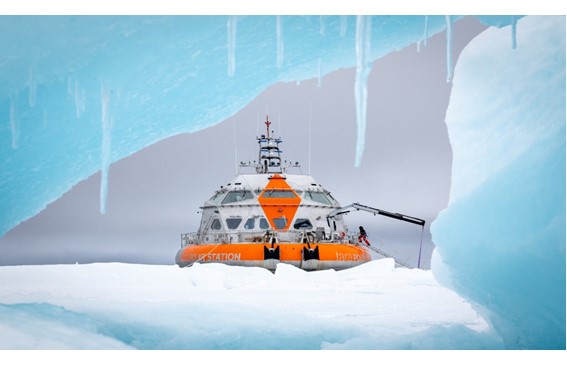 @Maéva
Bardy – Fondation Tara Océan
@Maéva
Bardy – Fondation Tara Océan
Observing today the Arctic of tomorrow
The first mission, Tara Polaris I, aims to establish an exceptionally detailed baseline of the Arctic ecosystem that will serve as a reference for monitoring its evolution over the coming decades.

| « Our mission will be to observe, document and archive its current state in order to build up invaluable records for the decades ahead,” explains Éric Pelletier, Research Director at Genoscope and a participant in the expedition.
|
Scientists will notably investigate the consequences of sea-ice melt and atmospheric or marine pollution on ecosystems. Above all, however, Tara Polaris will make it possible to continuously observe biological phenomena that remain poorly understood, including how microbial life survives the polar night and becomes active again as sunlight returns in spring.
These long-term observations will provide a better understanding of how microorganisms establish themselves and survive under such extreme conditions, and how they contribute to the functioning of the entire Arctic food web and major biogeochemical cycles.
Genoscope deciphers the DNA of Arctic life
Genoscope will play a central role in studying this biodiversity. Its teams will notably carry out DNA and RNA sequencing on samples collected throughout the expedition.
These genomic approaches will make it possible to characterize the microbial communities found in the Arctic Ocean, while also investigating their activity and their ability to adapt to environmental changes.
DNA analysis will provide an inventory of the biological potential contained in the collected samples, while RNA analysis will reveal which genes are actually being expressed and therefore provide information on the organisms’ activity at the time of sampling. Combining the two approaches will therefore make it possible to determine not only which organisms are present, but also what they are doing under different environmental conditions.
The researchers also hope to discover previously unknown species and identify new molecules produced by organisms adapted to the Arctic’s extreme conditions, potentially opening up new scientific or industrial opportunities in the future.
Nearly twenty years of research alongside Tara
This new adventure builds on a long-standing scientific collaboration. The CEA has been working alongside the Tara Ocean Foundation for nearly twenty years and has participated in previous expeditions dedicated to exploring marine biodiversity.
Environmental genomics approaches developed notably at Genoscope have helped reveal the extraordinary diversity of ocean microorganisms and improve our understanding of their interactions with their environment.
With Tara Polaris, this expertise is now being applied in one of the most difficult-to-access regions on Earth and one that is particularly exposed to climate-driven changes.
A scientific laboratory at the heart of the sea ice
For Eric Pelletier, the adventure will take on a very tangible dimension: nine months aboard Tara Polar Station, including several months without the possibility of resupply, with temperatures potentially dropping to -40°C or -50°C and several months spent in the darkness of the polar night.
Daily life will be largely shaped by an exceptionally intensive scientific programme: 236 observation protocols have already been planned.
One of the most eagerly anticipated periods will come in spring, with the gradual return of sunlight. Scientists will then be able to directly observe the awakening of microbial life and the reactivation of the ecosystem following the polar night.
“It is an extraordinary scientific marathon and a rewarding human experience,” concludes Éric Pelletier.
Contacts : Eric Pelletier et Julie Poulain