Tracking carbon to identify plastic-degrading bacteria
Polyhydroxyalkanoates (PHAs) are bio-based and biodegradable polymers that can degrade across a range of environments and are considered a potential alternative to certain conventional plastics. Their biodegradation in natural environments relies in particular on microorganisms capable of producing enzymes known as PHA depolymerases, which break down polymer chains into smaller molecules that can then be assimilated.
Plastics immersed in marine environments are rapidly colonized by numerous microbial species, forming a “plastisphere.” Distinguishing microorganisms that genuinely degrade the plastic from those that merely colonize its surface therefore represents a major challenge.
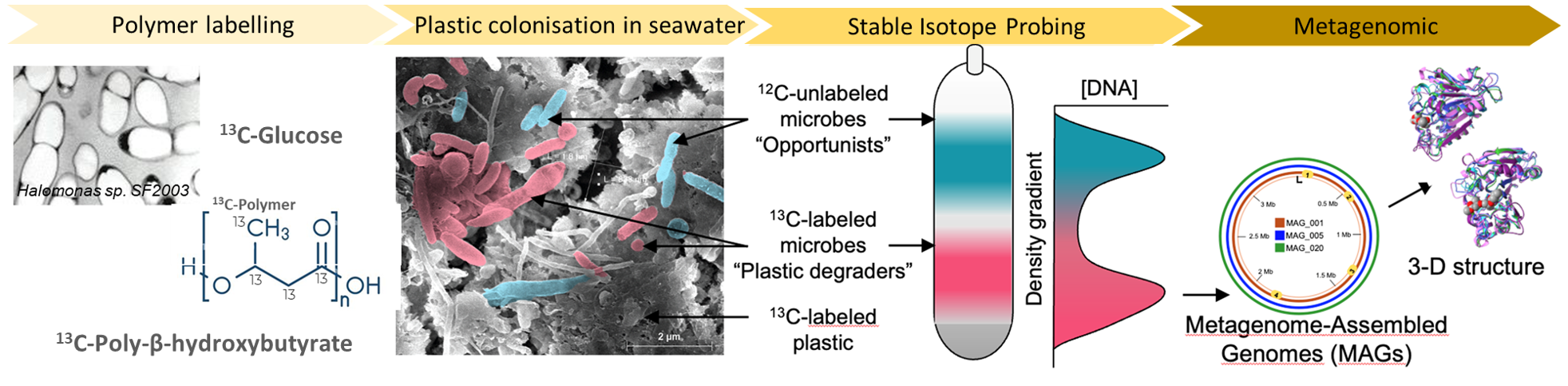
To address this question, the researchers used carbon-13-labeled poly(3-hydroxybutyrate) (PHB). When a bacterium degrades PHB and uses the carbon released in the process, the 13C is incorporated into its DNA. This technique, known as DNA stable isotope probing (DNA-SIP), makes it possible to isolate the DNA of microorganisms that have actually assimilated carbon derived from the polymer. When combined with metagenomics, it can then be used to reconstruct their genomes and identify genes potentially involved in polymer degradation.
An unexpected enzymatic arsenal
This approach identified several bacteria actively involved in PHB degradation. Three reconstructed genomes belonging to the genus Agarilytica particularly attracted the researchers’ attention.
They contained 9, 11 and 14 copies, respectively, of genes encoding extracellular ePhaZ depolymerases, whereas only one or two copies are generally reported in PHA-degrading bacteria. Comparative genomic analysis showed that this enzymatic repertoire arose in part through gene duplication and gene fusion events.
Even more remarkably, the fused proteins correspond to two complete depolymerases combined within a single enzyme, an organization that had never previously been described for this class of depolymerases. Three-dimensional modeling showed that these proteins retain the structural domains required for catalytic activity and suggested that some may interact with the polymer in different ways.
An adaptation to polymer degradation in marine environments
This expansion and diversification of depolymerases could provide bacteria with an advantage in exploiting PHB under variable environmental conditions, by increasing their efficiency or metabolic flexibility.
More broadly, the study highlights the value of combining DNA-SIP and metagenomics to directly link a biological function to the identity and genome of the microorganisms responsible for it within complex environmental communities.
Beyond improving our understanding of polymer biodegradation in the oceans, the newly identified depolymerases could also represent enzymes of interest for developing PHA biodegradation or biological recycling processes. These prospects nevertheless remain to be experimentally confirmed, as the study focused specifically on PHB and some of the enzymes identified have not yet been biochemically characterized.
Contact : Valérie Barbe