The terrestrial sulfur cycle reveals a previously overlooked bacterial pathway
A compound mainly studied in the oceans
Dimethyl sulfide, or DMS, plays an important role in the global sulfur cycle. Produced largely in the oceans from dimethylsulfoniopropionate (DMSP) by microalgae and marine bacteria, it accounts for a major fraction of natural sulfur emissions to the atmosphere. Once released, it can be oxidized and contribute to the formation of sulfate aerosols, which are involved in cloud formation and the regulation of the Earth’s albedo.
However, while its role in marine environments is well documented, DMS metabolism in soils remains much less well understood. Several terrestrial bacteria are nevertheless capable of producing or using this compound, suggesting the existence of specific metabolic pathways that have not yet been fully characterized.
Deciphering the Complete DMS Assimilation Pathway
To understand how terrestrial bacteria use DMS, the researchers focused on Acinetobacter baylyi ADP1, a soil bacterium well known for its broad metabolic versatility and ease of genetic manipulation.
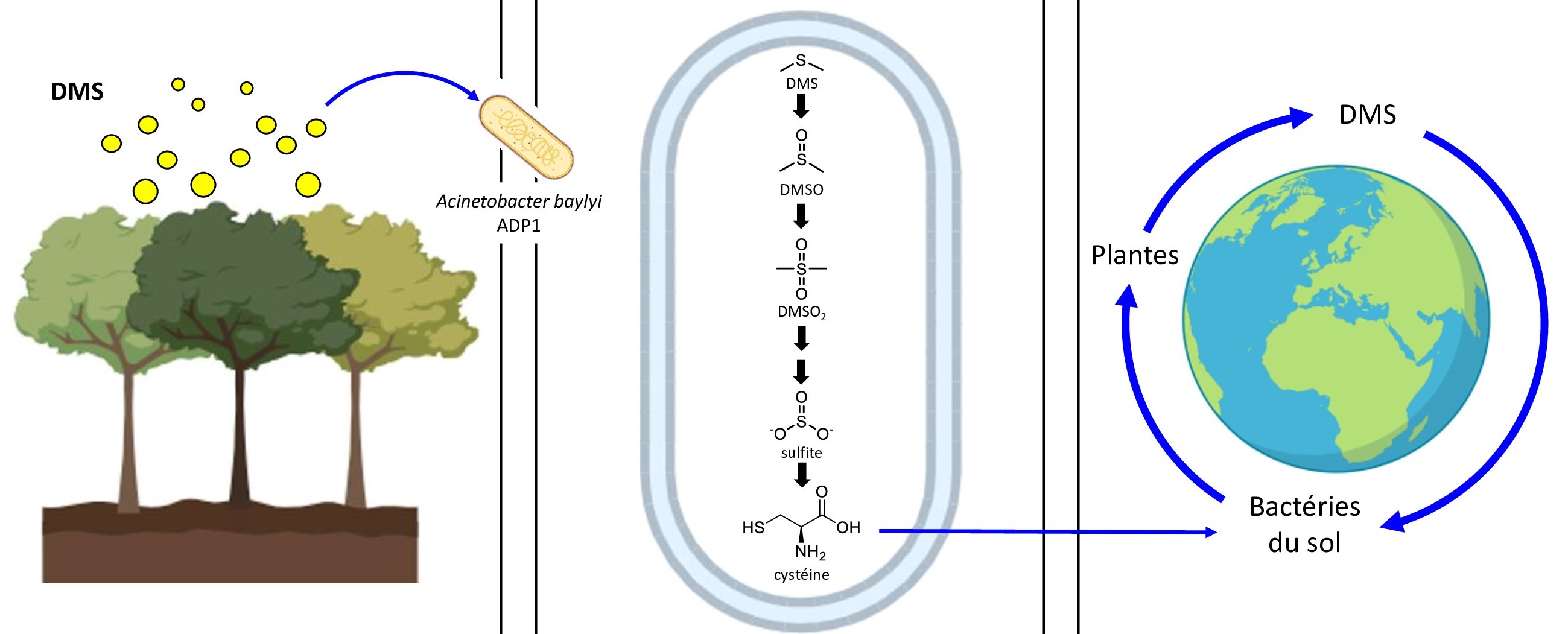
By combining targeted metabolomics, genetic mutants, enzymatic analyses and kinetic studies, they reconstructed the entire pathway that enables the bacterium to use DMS as a sulfur source.
DMS is first successively oxidized to dimethyl sulfoxide (DMSO) and then dimethyl sulfone (DMSO₂). The latter is subsequently converted into methanesulfinate and then methanesulfonate, before ultimately yielding sulfite. This sulfite is then incorporated into cellular sulfur metabolism and contributes, in particular, to cysteine biosynthesis.
Three New Enzymes for the First Steps of the Pathway
The initial steps of this pathway had previously been poorly characterized. The researchers therefore investigated several monooxygenases present in A. baylyi to identify those capable of oxidizing DMS and DMSO.
Three enzymes were identified and named Dms1, Dms2 and Dms3. All three can participate in the oxidation of DMS and DMSO, but Dms2 plays the predominant role. Experiments using mutants lacking these genes showed that, in the absence of dms2, growth on DMS is markedly reduced. Simultaneous deletion of dms1, dms2 and dms3 almost completely abolishes growth when DMS is the sole sulfur source.
These findings reveal a degree of functional redundancy between several enzymes: multiple monooxygenases are able to catalyze similar reactions and partially compensate for one another.
A Single Reductase Supporting the Entire Pathway
Another distinctive feature identified by the researchers is that all these monooxygenases use the same flavin reductase, MsuE, which provides the reduced cofactor required for their activity.
This organization is particularly noteworthy because a single protein can supply electrons to several enzymes involved in successive stages of DMS metabolism. The authors also show that several of these monooxygenases display a degree of substrate promiscuity, meaning that they can act on several structurally related sulfur compounds.
This enzymatic flexibility could provide bacteria with an advantage in environments where sulfur sources are variable or limited. It may also facilitate the rapid evolution of new metabolic capabilities without requiring the emergence of an entirely new enzymatic system.
A Pathway Activated When Sulfate Becomes Scarce
The researchers also showed that this metabolic pathway is strongly regulated by sulfur availability.
When sulfate, an easily assimilated sulfur source, becomes scarce, expression of the msuE, dms1, dms2, dms3, msuD and ssuD genes increases markedly. This response is consistent with the “sulfate starvation” mechanisms previously described in several bacteria, which enable them to activate alternative systems for capturing and assimilating other sulfur compounds present in the environment.
DMS therefore appears to serve as an alternative sulfur source that can be mobilized under sulfur-limiting conditions.
A Pathway Widely Distributed in Soils
The study was not limited to A. baylyi. Using genomic analyses, the researchers searched available bacterial genomes for homologues of the main enzymes involved in the pathway.
Nearly 300 organisms possess the key genes associated with this assimilation pathway. The vast majority belong to the genus Pseudomonas and are associated with terrestrial environments: 67% are linked to soils, while others are associated with plants or freshwater environments. The researchers also experimentally confirmed that Pseudomonas putida and Rhodococcus opacus can grow using DMS as a sulfur source.
Metagenomic analyses further support this observation. Genes involved in the early stages of DMS assimilation are far more abundant in terrestrial than in marine environments. They are found in agricultural soils, the rhizosphere and grasslands, and are particularly abundant in peatlands. The data presented show, for example, that dms1 and dms2 can reach especially high abundances in these organic matter-rich soils.
A New Piece of the Global Sulfur Cycle
These results broaden the traditional view of the DMS cycle, which has long been considered mainly from the perspective of marine ecosystems.
The presence of a complete assimilation pathway in numerous terrestrial bacteria suggests that DMS is also produced and recycled to a significant extent in soils and plant-associated environments. Its metabolism may therefore represent a terrestrial sink for reduced sulfur that has so far been insufficiently considered in models of the global sulfur cycle.
The authors highlight the particular importance of peatlands, where genes associated with DMS metabolism are especially abundant. In the context of climate change, drought events and increased oxygenation of some soils could promote aerobic microbial processes involved in DMS oxidation and thereby alter sulfur fluxes in these ecosystems.
By characterizing, for the first time, the complete set of enzymes involved in a full DMS assimilation pathway in a terrestrial bacterium, this Genoscope study reveals a still largely overlooked component of microbial sulfur metabolism in soils.
Contact : Alain Perret